
What Are Unmanaged Data Stores and How to Secure Them
Oct 7, 2026
Unmanaged data stores let permissions drift while sensitive data accumulates unnoticed. They are repositories an organization doesn’t actively govern, leaving them without an owner, an access-review cadence, or a retention policy. Securing them means assigning ownership, correcting access, and maintaining continuous governance and visibility.
In Netwrix’s 2026 Data and Identity Security Report, 76% of organizations don't immediately and automatically remove access to sensitive data when users no longer need it, and 71% can't immediately determine which identities have access to specific sensitive data. Even if a list of unmanaged data stores exists, it won't show who owns each one or when anyone last reviewed access.
An unmanaged data store is where data governance breaks down. A repository everyone likely knows about, with nobody accountable for what happens to it. This missing ownership weakens access visibility, audit readiness, and data security posture across on-premises, cloud, and SaaS environments. Closing it requires durable ownership and review controls that remain effective as systems and staff change.
What makes a data store unmanaged
An unmanaged data store appears in the inventory but has no active governance behind it: no named owner accountable for its contents, no scheduled access review, and no retention or disposition policy. It differs from an unknown data asset, which is missing from the inventory entirely; an unmanaged store is visible and unowned.
Picture a departmental file share every administrator can find in the configuration management database (CMDB). IT backs it up nightly, but the access control list (ACL) still carries a Domain Users entry from a migration, and the listed owner left three years ago. Nobody decides who should have access or what to delete.
The National Institute of Standards and Technology Cybersecurity Framework (NIST CSF) 2.0 requires inventories of data and corresponding metadata, while the Center for Internet Security (CIS) Controls v8 requires a documented data management process to address the data owner; that share satisfies the inventory requirement but fails the owner requirement.
Why data stores go unmanaged even when IT knows they exist
Naming a repository once doesn't keep it governed. Ownership lapses for specific, recurring reasons, and each one leaves behind a store IT can still see, but nobody administers.
- Ownership turnover: The person who created or administered a share leaves or changes roles, and the store outlives their tenure with no formal handoff. Deleting an owner's account in Microsoft 365 leaves the connected team or group ownerless, with no automatic reassignment.
- Merger and reorganization debt: Acquired systems and consolidated departments leave behind repositories nobody on the current org chart owns. AIIM describes unstructured data as " a critical blind spot" in mergers and acquisitions (M&A) integration, with files moved while nobody is assigned to govern them.
- Bundled provisioning: IT provisions storage as part of a larger rollout without assigning a named owner at creation, so governance never starts. Microsoft acknowledges that as site counts grow, administrators struggle to identify inactive and ownerless sites or sites that no longer meet business requirements.
- Review fatigue: Access review programs exist on paper and lapse in practice once the first audit cycle ends. A 2024 academic study found that reviewers expected excessive authorizations but revoked few of the authorizations they reviewed.
These patterns make owner validation a lifecycle control, not a one-time inventory task.
[netwrix-cta:product=netwrix_access_analyzer;variant=mid]
The risk an unmanaged data store creates is different from an unknown one
An unknown asset carries risk because no control reaches it. An unmanaged store carries risk because controls reached it once and then stopped, leaving a visible gap in data security posture and audit readiness.
Permissions drift further the longer nobody owns the store
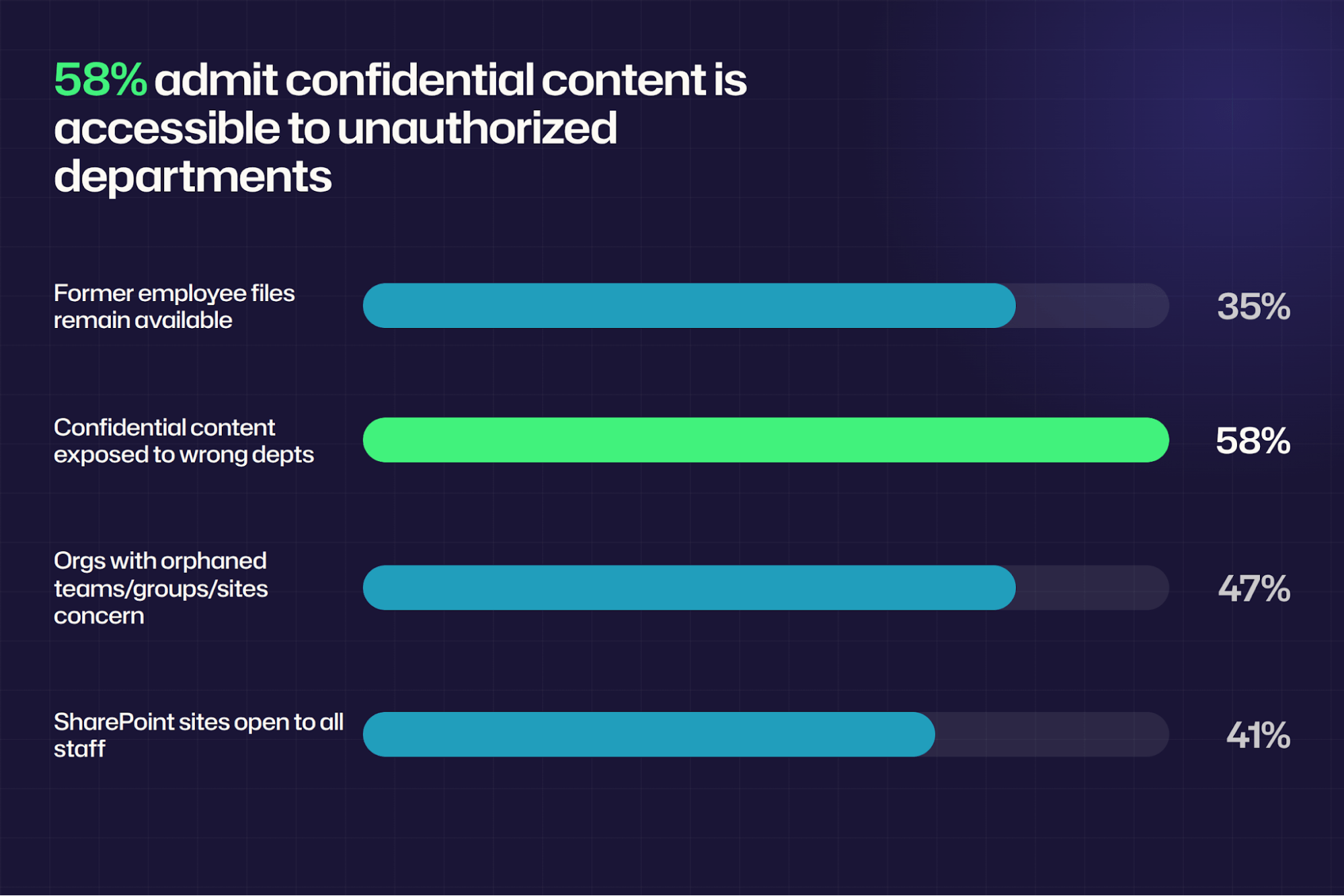
Without an owner to prune access, group membership and permission grants can accumulate. The commercial Syskit State of M365 Governance Report 2026 found 58% of security decision-makers admit confidential content is accessible to departments that should not see it.
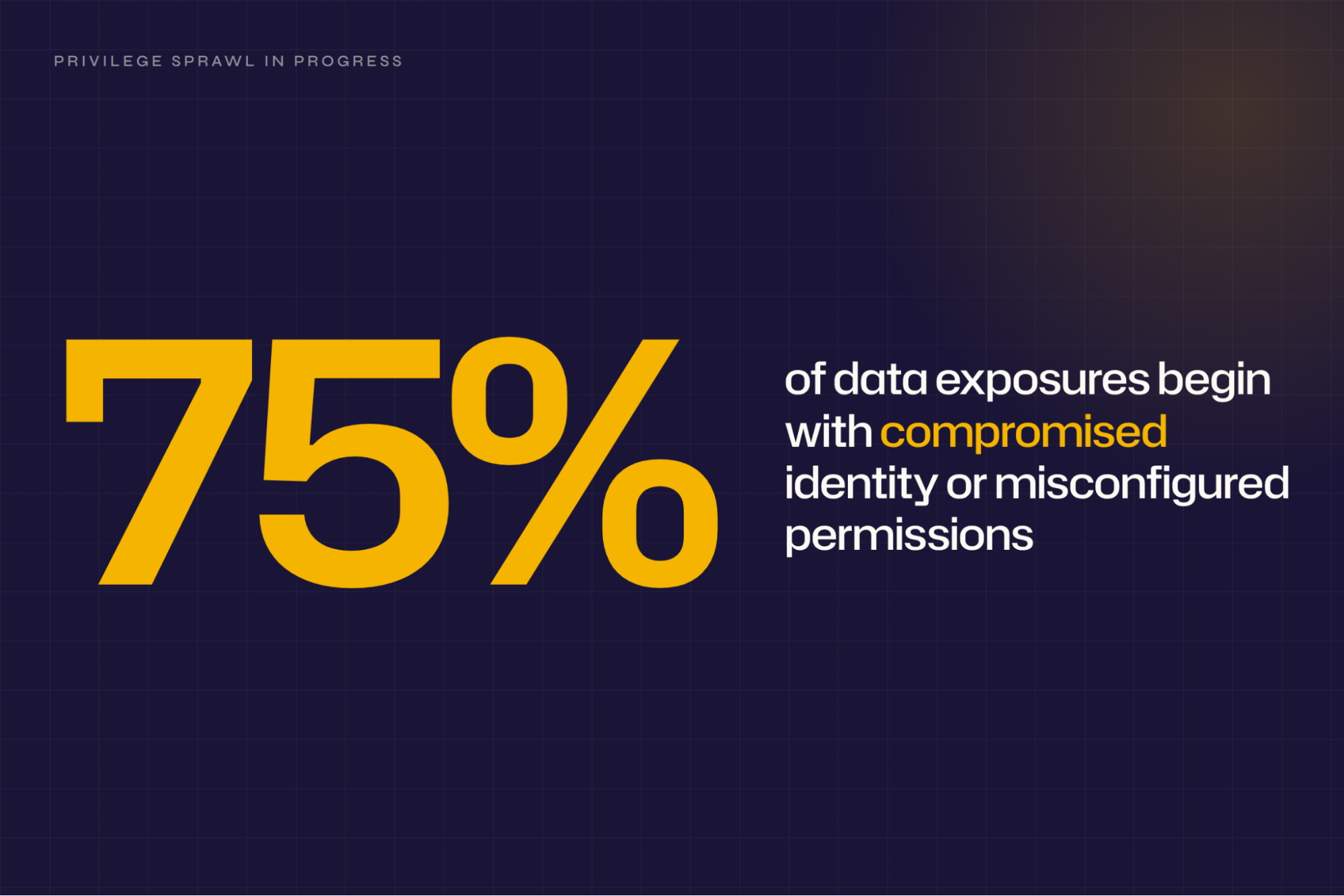
The Netwrix 2026 Data and Identity Security Report finds that 75% of incident-based data exposures begin with a compromised identity or misconfigured permissions, and The Verizon 2026 Data Breach Investigations Report reports that resolving half of weak-password and permission-misconfiguration findings takes almost eight months. Continuous access visibility helps teams correct that drift before it becomes an audit exception or a persistent security posture gap.
Protocol paths bypass the controls on the sanctioned front door
A store can have one governed way in and several nobody lists. A picture archiving and communication system (PACS), for example, can password-protect its web viewer while its Digital Imaging and Communications in Medicine (DICOM) service still answers on the protocol port.
Trend's May 2026 research found 3,627 DICOM imaging servers reachable from the internet, and 99.56% accepted connections without Application Entity (AE) Title validation.
The same split shows up on file shares reachable over Server Message Block (SMB) as well as a web portal, and on databases and storage buckets with direct port or API access. Ownership and review cover only the paths someone knows to list.
Compliance and audit findings land on unmanaged stores first
An asset register with unassigned owners fails NIST CM-8(4) because the control requires identifying responsible and accountable individuals. In a System and Organization Controls (SOC) 2 Type 2 examination, auditors test periodic access reviews under CC6.3. Missing evidence appears in the tests-of-controls section as exceptions that factor into the auditor's opinion.
Deer Oaks Behavioral Health reached a settlement after a discontinued patient portal left electronic protected health information (ePHI) publicly accessible, with the Office for Civil Rights (OCR) citing "failing to identify where ePHI was located in the organization" and "failing to perform regular review of information system activity."
The enforcement action shows how weak inventory and review controls can leave sensitive systems exposed. Clear ownership and review evidence reduce audit preparation effort and make accountability defensible.
A repeatable method for bringing unmanaged data stores under governance
Every step below applies to a store IT already knows about, so the work starts at ownership.
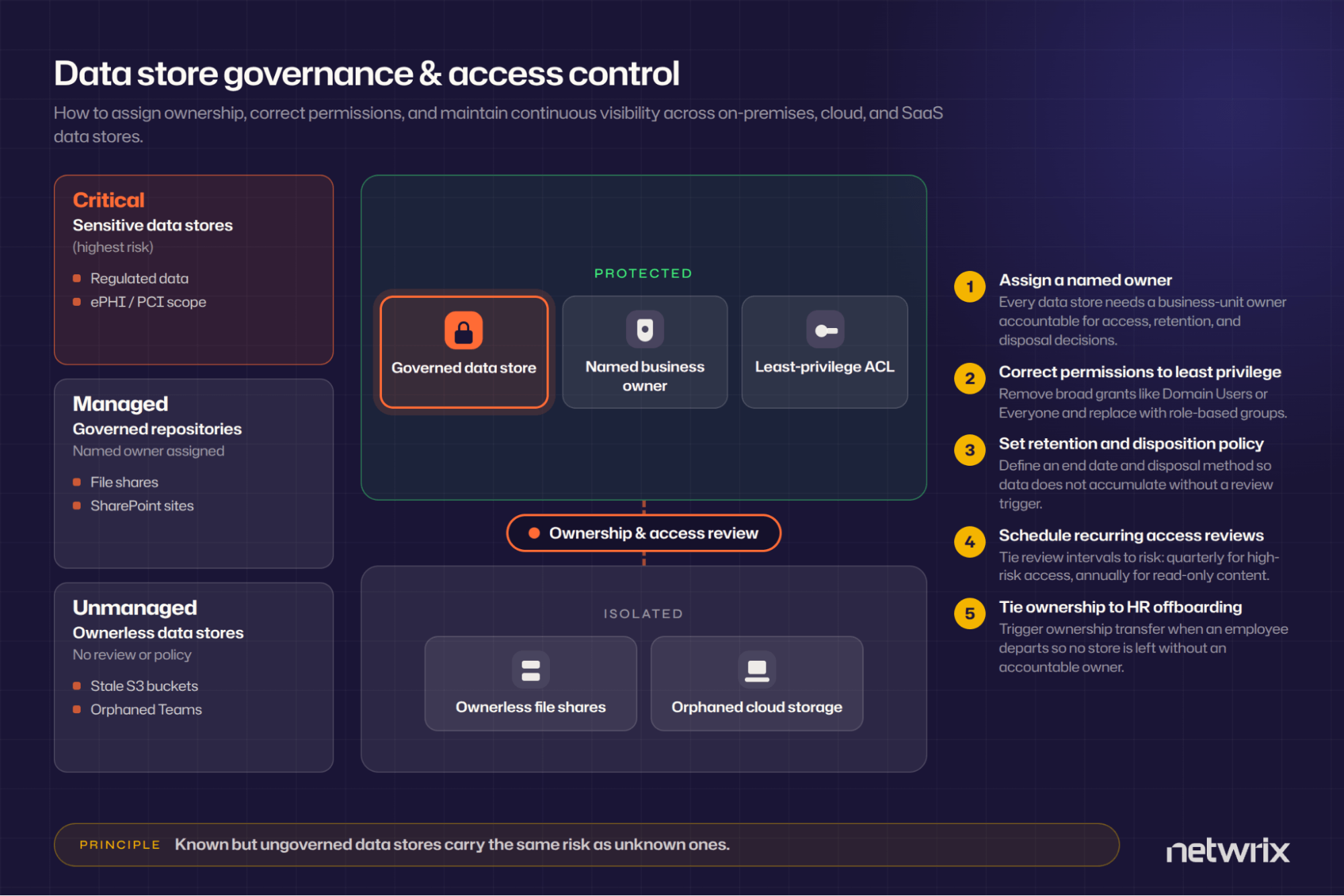
1. Inventory every known data store and flag any without a currently assigned, named owner
Record owner, custodian, classification, location, retention rules, and last review date for each entry; CIS Controls v8 requires a documented data management process that addresses data sensitivity, data owner, handling, retention limits, and disposal requirements. Treat an owner field that resolves to a disabled account or a generic IT group as empty.
2. Assign an accountable owner from the business unit that uses the store
ISACA states it directly: "The IT function may process data, store data, back data up and perform other services, but it doesn’t own the data." The owner decides who may access the data and authorizes its disposal; IT retains the custodian role. Keep the two roles separate so accountability and responsibility don’t sit with one person.
3. Run an access review against each store and correct permissions to least privilege
A data access review must resolve nested group membership before removing anything, because a user's effective access often comes through a chain of groups.
Microsoft documents that nested memberships remain after Microsoft Entra ID access reviews, so the user keeps access to the reviewed resource. On Windows shares, remove the Everyone group and replace it with role-based groups. On SharePoint Online, remove "Everyone except external users" exposure and delete Anyone links, because Microsoft can't audit the access they grant.
Before you close the review, list every way into the store, such as the web portal, SMB, NFS, FTP, a database port, a storage API, or a sharing link, and apply the same access rules to each. A control on the web front end doesn't cover a protocol path that bypasses it.
4. Set a retention and disposition policy with a defined end date
NIST SP 800-53 Rev. 5 covers the full information lifecycle and requires organization-defined disposal techniques following the retention period. For Microsoft 365 content, use retention labels when disposition review is required, since retention policies limit disposition review. Microsoft Purview retention policies exclude file shares, so legacy shares need a separate mechanism. Check for legal holds before any deletion.
5. Schedule a recurring review cadence for every store
Tie the interval to risk: PCI DSS v4.0 Requirement 7.2.4 mandates reviewing all accounts at least every six months, and ISACA recommends a risk-based cadence with "high-risk transactional access quarterly and read-only access annually." Write the next review date into the asset register so the cadence survives whoever set it.
These steps create repeatable evidence for auditors, reduce manual access analysis, and strengthen your data security posture.
Where unmanaged data stores accumulate fastest
Common accumulation points combine stale content, persistent access, and weak ownership records.
- Legacy file shares tied to decommissioned teams: Komprise estimates that 60–70% of data in most enterprises has gone unaccessed for a year or more, so stale data ages in place with no automated prompt to review it.
- SharePoint sites created for one-off projects: The commercial Syskit State of M365 Governance Report 2026 found 47% of organizations identify orphaned teams, groups, and sites as a primary concern and 41% leave SharePoint sites accessible to all staff without restrictions. Microsoft's inactive site policy can catch these, but it requires the SharePoint site-management add-on or a Microsoft 365 Copilot license.
- Cloud storage left behind after a completed migration: Abandoned storage stays reachable: watchTowr found abandoned Amazon S3 buckets still receiving requests from government agencies, banks, and large companies.
- Shared mailboxes and Teams channels left active after a project ends: Microsoft states that a shared channel with no remaining organizational members "remains ownerless", and a Teams admin must manually assign a channel owner. Shared mailboxes create a larger visibility gap: the mailbox usage report "shows only a count of shared mailboxes" because they have no activity independent of a user mailbox.
These environments need ownership checks tied to lifecycle events because inactivity alone doesn't remove access or establish accountability.
How to keep a governed data store from going unmanaged again
Lifecycle controls preserve ownership as people, roles, and business requirements change.
Require a named business owner at provisioning as a hard gate
ISACA recommends ownership at provisioning: "documenting the ownership of collected or generated data be addressed in the planning stages to avoid having to do so retroactively." In SharePoint Online, the site ownership policy can set a minimum owner count; setting the minimum to 2 flags single-owner sites for remediation before they reach zero.
Tie data ownership records to human resources (HR) offboarding
NIST SP 800-53 AC-2 requires offboarding notification: "Notify account managers … within [organization-defined time period] when users are terminated or transferred."
Microsoft Entra ID Governance Lifecycle Workflows trigger on the employeeLeaveDateTime attribute. The attribute comes from Workday or SAP SuccessFactors. The predefined leaver tasks remove group and Teams membership. Pair the workflow with an ownership-transfer step that queries the asset register for every store the departing person owns.
Run access reviews on a fixed calendar and add event triggers on top of it
ISACA also recommends event-triggered certifications when the identity system detects role or entitlement changes, along with fixed-interval certification for anything untouched. Watch the outcomes as well as the dates: high-volume review requests can lead to fatigue and systemic rubber-stamping.
Treat two consecutive failed reviews as a decommissioning trigger
A store that repeatedly lacks an authorized reviewer may no longer have a defensible business justification. Microsoft's inactive site policy models the path: three monthly notifications, then read-only mode for 3, 6, 9, or 12 months depending on the configured read-only period, then archive.
These controls turn ownership into a durable operating process, reduce repeated remediation work, and strengthen cyber resilience through continuous governance.
How Netwrix Access Analyzer keeps data stores under active ownership
Data access governance ties repository ownership, effective permissions, and recurring certification together in one workflow. Netwrix Access Analyzer is an enterprise data access governance product that analyzes probable ownership and effective access across supported data sources. It directly supports the three steps above.
Surface every store with no assigned owner
Finding an owner for a legacy share often means guessing from activity logs. Access Analyzer replaces the guesswork with a ranked candidate list drawn from actual usage patterns.
- Ranks probable owners for Windows and NAS shares by a weighted score of content ownership, management activity, and access frequency
- Populates the Share Audit report's Probable Owner card from Netwrix Activity Monitor events
- Reports the most likely owner of a SharePoint resource through the SP_ProbableOwner job
- Surfaces ownership candidates for known shares so teams can prioritize stores that may lack a current owner
For Windows and NAS file systems, step one of the method can rely on this standing report to nominate owners without manually tracing every activity record.
Correct access to what a user actually holds
Raw ACLs rarely reflect who can actually reach a file, because nested group membership hides the real access path. Access Analyzer resolves that chain so remediation targets effective permissions.
- Counts a folder as open when Everyone or Domain Users can reach it directly or through a nested group
- Expands Microsoft Entra ID group memberships during Effective Permissions Calculation when a completed identity sync exists for the tenant
- Shows the access a user actually holds, not the raw ACL entries
- Gives business owners defensible evidence for least-privilege decisions
Step three of the method then works from effective access rather than a permission list, replacing manual permission-by-permission review with a clearer remediation target.
Keep review cadence from lapsing
A review program only holds up when business owners can act without wrestling with an admin console. Access Analyzer routes decisions to the people closest to the data and records the outcome.
- Routes review tasks to the data and application owners who understand each store
- Lets Review Administrators Accept, Decline, or Defer recommended changes through the Access Information Center
- Supports scheduled automated access review campaigns that approve or revoke user and group access
- Preserves a decision trail that shortens audit preparation
These controls keep the cadence from lapsing between audits and produce the evidence auditors ask for under frameworks like SOC 2 CC6.3 and PCI DSS Requirement 7.2.4.
Start with the stores nobody claims
Prioritize stores with no verified owner because access drift continues until someone accepts accountability. Rank them by data sensitivity, breadth of effective access, inactivity, and regulatory scope, then require an ownership decision before further investment. For hybrid environments that include Amazon S3 and Azure Blob storage, Netwrix DSPM extends data security posture management (DSPM) coverage across supported on-premises and cloud sources.
Frequently asked questions about unmanaged data stores
Share on
Learn More
About the author

Netwrix Team
Learn more on this subject
Insider risk starts with who can read the data
NIST CSF 2.0: What's new in the Cybersecurity Framework
From noise to action: turning data risk into measurable outcomes
Data Privacy Laws by State: Different Approaches to Privacy Protection
What Is Electronic Records Management?