
7 Oracle Identity Governance alternatives for enterprise IGA in 2026
Jul 5, 2026
Oracle Identity Governance alternatives matter now because Oracle Fusion Middleware 12c support is winding down, and its custom Java connectors and workflows don't carry over to any new platform. Replacing a mature on-premises identity governance program means weighing the migration path, deployment model, depth of segregation of duties, and total cost of ownership before the support window closes.
Breaches take an average of 241 days to identify and contain, according to the IBM 2025 Cost of a Data Breach Report. The Netwrix 2025 Cybersecurity Trends Report found that 75% of organizations took financial damage from attacks in 2025, up from 60% a year earlier.
Much of that dwell time and cost traces back to access no one governs: standing entitlements, orphaned accounts, and toxic role combinations that go unreviewed. Moving to a supported identity governance and administration (IGA) platform is how teams close that gap before it widens.
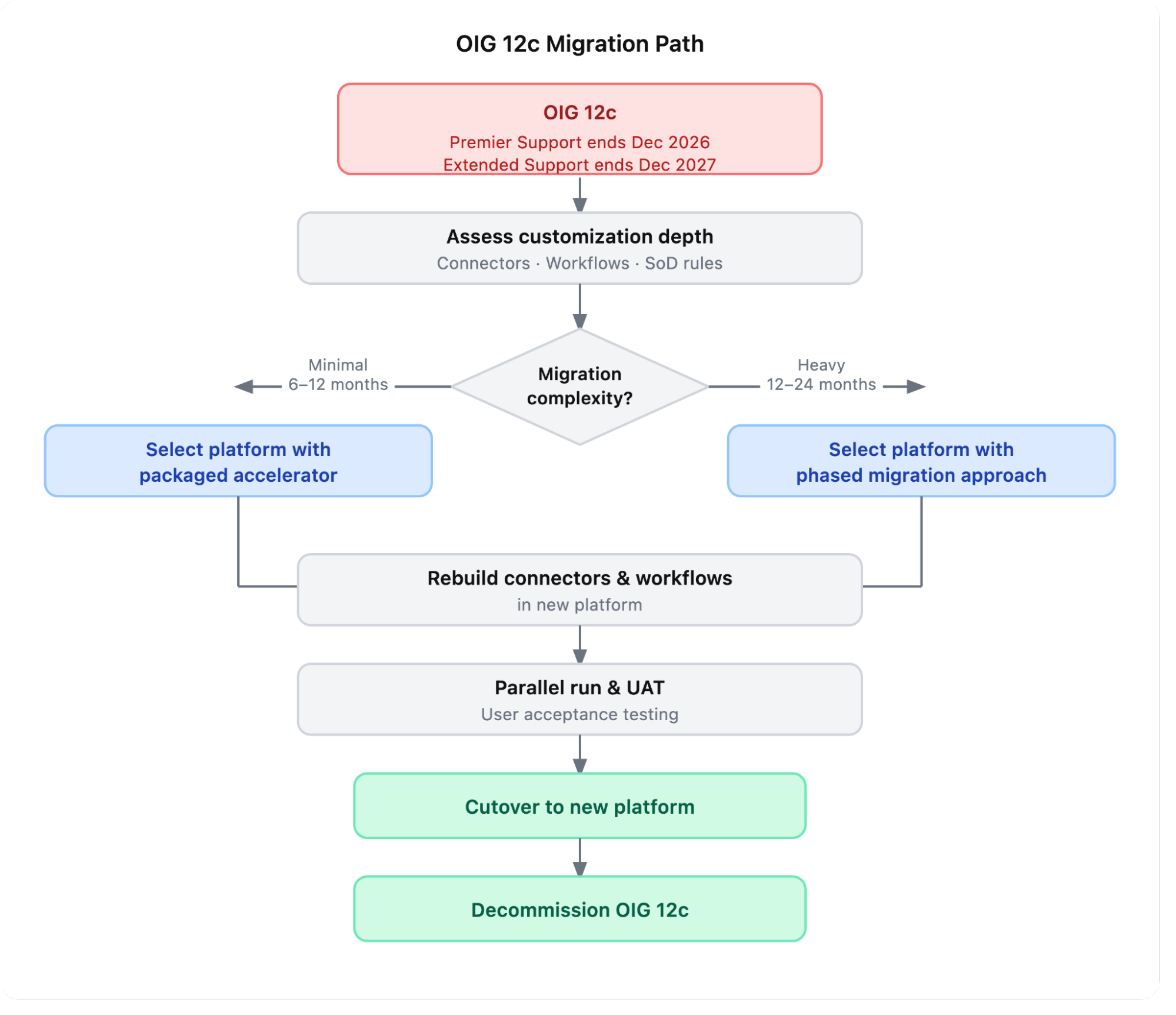
Oracle Identity Governance (OIG) runs on Oracle Fusion Middleware, and 12c Premier Support ends in December 2026, with Extended Support ending a year later.
After that, OIG 12c stops receiving security patches, and because every connector and workflow is custom Java that won't port to a new platform, evaluating Oracle Identity Governance alternatives early is the difference between a planned migration and a forced one.
This guide compares seven Oracle Identity Governance alternatives on migration path, deployment model, segregation of duties depth, and total cost of ownership.
7 Oracle Identity Governance alternatives at a glance
Tool | Deployment model | Migration path from OIG | Best for |
|---|---|---|---|
|
Netwrix Identity Manager |
Hybrid (on-prem + cloud) |
No-code rebuild of connectors and workflows; structured migration |
Hybrid Microsoft-centric enterprises leaving OIG |
|
Saviynt Enterprise Identity Cloud |
SaaS (region-selectable hosting; no traditional on-prem) |
Full rebuild in Saviynt, accelerated by prebuilt ERP connectors |
Enterprises needing SAP or Oracle EBS SoD in a cloud-native platform |
|
Microsoft Entra ID Governance |
Cloud-native SaaS |
Native for M365 and Azure; partner tooling needed for non-Microsoft apps |
Microsoft-heavy enterprises already licensed for Entra ID Governance |
|
Omada Identity |
SaaS, on-prem, private cloud |
12-week Oracle IAM accelerator (defined scope); full rebuild for heavy customizations |
Structured fast OIG migration, especially under European regulatory requirements |
|
One Identity Manager |
On-prem, hybrid |
SI-led full rebuild; no packaged OIG accelerator |
Enterprises consolidating complex AD, SAP, and PAM under one vendor |
|
IBM Verify Identity Governance |
On-prem, hybrid |
SI-led migration; Oracle EBS and PeopleSoft connectors available |
Large enterprises with IBM mainframe or QRadar-anchored security operations |
|
CyberArk Identity Governance |
Cloud and on-prem (via CyberArk/Idira) |
PAM-first; IGA module under two years old; maximum value for existing CyberArk customers |
Existing CyberArk PAM customers extending to entitlement governance |
OIG 12c migration path
Why teams are considering alternatives to Oracle Identity Governance
OIG buyers aren't evaluating IGA for the first time. They're migrating a mature, complex program, and the pressure to move clusters around a few recurring problems.
- Custom Java is expensive to maintain: Every OIG connector and workflow is hand-built in Java EE, which makes upgrades, audits, and staffing harder than on codeless or no-code platforms.
- No native AI or non-human identity governance: OIG predates AI-assisted access decisions and machine-identity governance, both of which are now baseline expectations in enterprise IGA.
- Migration is a full rebuild: Connectors and workflows don't carry over, so the closing support window forces a platform decision rather than a version bump.
- Specialized OIG talent is scarce: The pool of engineers fluent in OIG customization continues to shrink, raising both project risk and run-rate costs.
- Total cost of ownership: Running OIG on the Oracle Fusion Middleware and WebLogic stack entails significant infrastructure, licensing, and specialist staffing costs that compound over time.
What to look for in an Oracle Identity Governance alternative
Replacing a heavy on-premises IGA platform with filters for criteria that first-time buyers don't weigh. These are the ones that separate a clean migration from a stalled one.
- IGA depth without custom code: Confirm that lifecycle automation, access request workflows, certification campaigns, and role-based access control (RBAC) work out of the box. Segregation of duties (SoD) controls deserve the closest scrutiny.
- Deployment model fit: Cloud-native platforms may offer no on-premises option, whereas traditional suites support hybrid deployments. In regulated industries with data residency rules, confirm that the model covers your full entitlement scope.
- AI and non-human identity (NHI) governance: OIG has no native AI capabilities, and NHI governance is now a baseline requirement. Service accounts, API keys, and machine credentials outnumber human identities by reported ratios of 10:1 to more than 80:1.
- Migration path and timeline: OIG migrations rebuild every connector. Ask for a defined-scope accelerator and a realistic timeline, since full-scope implementations on larger platforms often take more than 12 months.
Netwrix Identity Manager automates joiner-mover-leaver workflows across hybrid Active Directory and Entra ID without code. Request a demo.
The 7 best Oracle Identity Governance alternatives for enterprise IGA in 2026
The seven platforms below span converged IGA and privileged access management (PAM) suites, cloud-native SaaS, and hybrid enterprise platforms with deep SAP and mainframe coverage.
1. Netwrix Identity Manager
Netwrix Identity Manager is the identity governance and administration solution in the Netwrix 1Secure™ platform. It's built for hybrid Microsoft environments rather than the heavy, Fusion Middleware-based suite Oracle Identity Governance runs on.
Key features:
- No-code lifecycle automation: Joiner-mover-leaver provisioning and deprovisioning across hybrid Active Directory and Entra ID through configurable workflows, replacing OIG's custom Java connectors with configuration.
- Access certification: Owner-driven attestation campaigns that recertify entitlements on a schedule and generate audit-ready evidence for SOX, HIPAA, PCI DSS, and ISO 27001.
- Non-human identity governance: Service accounts, API keys, and machine identities are governed under the same policies as human accounts, the kind of coverage OIG lacks natively.
- Prebuilt connectors: Out-of-the-box integrations for Active Directory, Entra ID, HR systems, and major SaaS applications to synchronize identities and entitlements.
What to consider:
- Coverage is deepest across Active Directory and Entra ID, so non-Microsoft identity providers may need supplemental tooling.
- Deep SAP, Oracle E-Business Suite, and mainframe segregation-of-duties scope needs connector-depth validation before shortlisting for those applications.
- Teams replacing a heavily customized OIG deployment should scope the migration deliberately, since connector and workflow logic is rebuilt rather than ported.
Best for: Hybrid Microsoft-centric enterprises leaving OIG that need no-code identity governance without a multi-month rebuild.
2. Saviynt Enterprise Identity Cloud
Saviynt is a cloud-native, converged platform that unifies IGA, application access governance, and privileged access within a single SaaS architecture. It competes directly with OIG in enterprise SoD, shipping out-of-the-box rule sets for major enterprise resource planning (ERP) and business applications.
Key features:
- Cloud-native SaaS architecture unifying IGA lifecycle management, certifications, and SoD controls without separate modules for core governance.
- Application access governance with fine-grained SoD analysis and privileged access controls across enterprise business applications.
- Out-of-the-box SoD rulesets for SAP, Oracle E-Business Suite, NetSuite, Salesforce, PeopleSoft, and Workday.
What to consider:
- No on-premises deployment option, so regulated programs with data-residency requirements must evaluate cloud data handling first.
- AI-driven automation claims have limited independent validation, so confirm automation rates against a proof of concept.
Best for: Enterprises moving to cloud-native IGA that need SAP or Oracle EBS SoD controls in the core platform.
3. Microsoft Entra ID Governance
Microsoft Entra ID Governance adds lifecycle workflows, access packages, and access reviews to the Microsoft identity stack for Microsoft 365, Azure, and connected SaaS applications. It delivers governance natively in the cloud, without OIG's on-premises footprint.
Key features:
- Lifecycle workflows for joiner-mover-leaver automation with Workday and SAP SuccessFactors as HR sources.
- Access packages with multi-stage approval workflows and segregation-of-duties checks for access requests.
- Native integration with Microsoft Entra Privileged Identity Management (PIM) across the broader Entra ID governance stack.
What to consider:
- Governance for non-Microsoft legacy applications needs supplemental tooling, such as a partner solution for fine-grained SAP SoD.
- Entra PIM scopes only to Microsoft Entra, Azure, and Microsoft 365 roles and does not support credential vaulting or session recording for non-Microsoft systems.
Best for: Microsoft-heavy enterprises already licensed for the Entra ID Governance add-on SKU.
4. Omada Identity
Omada is a purpose-built enterprise IGA platform with a codeless configuration model. Its Identity Cloud Accelerator targets a 12-week, defined-scope migration path off Oracle IAM, which is what brings it into most OIG shortlists.
Key features:
- Codeless IGA configuration via the IdentityPROCESS+ framework with SoD controls in the core platform.
- Defined-scope Oracle IAM migration accelerator targeting 12 weeks, including connected identity sources, governance workflows, and operational training.
- Feature parity across SaaS, on-premises, and private-cloud hybrid deployment models.
What to consider:
- The 12-week accelerator applies to a defined scope, so heavily customized Oracle environments should not assume it applies.
- AI and NHI governance capabilities are still maturing relative to cloud-native converged platforms.
Best for: Enterprises that want a structured, fast OIG migration, especially under European regulatory requirements.
5. One Identity Manager
One Identity Manager is a unified IGA and privileged access governance platform with deep coverage of Active Directory, SAP, and multi-system environments. Its differentiator is governing identities and privileged activity together through One Identity Safeguard for credential vaulting and session recording.
Key features:
- Deep Active Directory, Entra ID, and SAP integration with SoD conflict detection and enforcement across SAP.
- Unified IGA and privileged access governance with Safeguard integration for credential vaulting and session brokering.
- Identity and privileged activity monitoring that can flag anomalous behavior across connected systems.
What to consider:
- Implementations are widely reported as time-consuming and complex, requiring experienced staff to deploy and operate.
- The legacy Web Designer interface draws consistent criticism from practitioners, and the modern interface requires a manual upgrade.
Best for: Enterprises consolidating complex AD, SAP, and multi-system IGA and PAM under one vendor.
6. IBM Verify Identity Governance
IBM Verify Identity Governance, formerly IBM Security Verify Governance, brings business-activity-based governance and audit depth across large, heterogeneous enterprise environments. It fits organizations whose security operations are already anchored in the IBM ecosystem.
Key features:
- Business-activity-based SoD analysis for financial and operational compliance at enterprise scale.
- Active adapter ecosystem including Oracle E-Business Suite and PeopleSoft connectors.
- On-premises and hybrid deployment for organizations with strict data-residency requirements.
What to consider:
- Implementation and ongoing management typically require a dedicated identity team and a partnership with a systems integrator.
- User interface and deployment agility trail newer cloud-native platforms, adding operational overhead relative to SaaS alternatives.
Best for: Large enterprises with IBM mainframe, legacy IBM infrastructure, or QRadar-anchored security operations.
7. CyberArk Identity Governance
CyberArk Identity Governance is the IGA module layered on CyberArk's PAM platform. It adds entitlement governance on top of CyberArk's privileged access management, approaching IGA from a PAM foundation. CyberArk added the capability through its February 2025 acquisition of Zilla Security and was itself acquired by Palo Alto Networks in February 2026.
Key features:
- IGA lifecycle management and access certifications are integrated with CyberArk PAM vault infrastructure.
- Entitlement governance and least-privilege management spanning on-premises and cloud applications.
What to consider:
- The IGA capability is less than two years old, so its certification and SoD depth trail established IGA platforms.
- Maximum value accrues to existing CyberArk PAM customers; as a standalone IGA purchase, breadth trails established platforms.
Best for: Existing CyberArk PAM customers extending governance to standard entitlements without a separate IGA vendor.
Choose the right Oracle Identity Governance alternative
With the December 2026 support deadline approaching, the deciding factor is whether a platform can stand up governance quickly, without a year of custom rebuilding.
For hybrid Microsoft-centric teams managing an OIG migration, Netwrix fits that profile. Netwrix Identity Manager replaces custom Java lifecycle and certification workflows with no-code configuration.
From there, Netwrix Access Analyzer ties entitlements to the sensitive data that each identity can access, and Netwrix Privilege Secure enforces zero standing privilege, so migrated accounts retain no persistent elevated rights.
Together, they keep access aligned with the principle of least privilege and produce audit-ready evidence as the environment changes.
Request a demo to see how Netwrix can help you migrate off Oracle Identity Governance, govern hybrid Active Directory and Entra ID, and produce audit-ready compliance evidence.
Disclaimer: The information in this article was verified as of June 2026. Please verify current capabilities directly with each provider.
Frequently asked questions about Oracle Identity Governance alternatives
Share on
Learn More
About the author

Netwrix Team
Learn more on this subject
Who owns your AI agents? Probably no one
Getting your IGA project right: Start with personas
They did everything right on identity hygiene. They got breached 4x more often
AI governance strategy: Beyond the compliance facade
Teams sprawl: Managing Microsoft Teams proliferation