
Purple Knight vs. Tenable One Identity Exposure
Oct 20, 2026
Active Directory exposures accumulate quietly between scans, so assessment cadence decides staffing, cost, and what a team can prove to an auditor months later. A free on-demand scan establishes a baseline and stops there. A licensed platform monitors the directory without pause and fires while the attack is still in progress. Change auditing supplies the before-and-after record that proves a fix held.
Phishing, vishing, and stolen credentials accounted for 38% of the major incidents Wavestone's Computer Emergency Response Team handled in 2025, nearly double the 20% recorded a year earlier, per the firm's 2025 incident response report.
Compromised credentials increasingly mean compromised Active Directory, since a stolen login is often all an attacker needs to start moving through the directory.
Despite that shift, the Netwrix 2026 Data and Identity Security Report found that only 36% of organizations ran a comprehensive AD security assessment in the past 12 months.
In the same survey, 74% weren't fully confident their AD was free of misconfigurations that enable privilege escalation. Most teams don't currently know where their AD actually stands.
Purple Knight and Tenable One Identity Exposure both aim to close that visibility gap, just in different ways.
Quick comparison of Purple Knight and Tenable One Identity Exposure
The table below lines up cost, cadence, directory coverage, attack response, remediation, and audit evidence for Purple Knight and Tenable One Identity Exposure.
Dimension | Purple Knight | Tenable One Identity Exposure |
|---|---|---|
|
Cost model |
Free download |
Licensed per identity, quote-based |
|
Assessment cadence |
On-demand scans |
Live monitoring |
|
Directory coverage |
AD, Entra ID, Okta |
AD and Entra ID |
|
Attack response |
Reports what a scan finds |
Alerts on attacks in progress |
|
Remediation |
Guidance only |
Guidance plus scripts |
|
Audit evidence |
Scan-date snapshot |
Alert history |
Why buyers compare Purple Knight and Tenable One Identity Exposure
Both products scan Active Directory and Microsoft Entra ID, score what they find, and publish indicator catalogs, which puts them on the same shortlist for genuinely different jobs.
Free versus licensed forces a budget conversation
Purple Knight costs nothing to download, while Tenable One Identity Exposure requires a quote-based license per identity and an enablement step before the first finding arrives. Budget owners want to know what the free baseline buys before approving a recurring line item, and that question alone puts these two tools in the same evaluation.
Broader searches for Purple Knight alternatives and Semperis alternatives span several product categories, since the two tools sit in adjacent markets; a two-tool decision narrows the question to what the next 90 days need to produce.
Point-in-time scans and continuous monitoring set different cadences
Purple Knight runs on demand, one scan at a time, capturing the directory as it looked at that moment. Tenable One Identity Exposure runs without pause and pairs that with real-time identity threat detection and response (ITDR).
It can see a privileged group change or a Group Policy Object edit the moment it lands, rather than waiting for the next scheduled scan. Teams weighing the two are really choosing an operating cadence, not just a feature list.
Overlapping indicator catalogs invite an apples-to-oranges score
The acronyms on both product pages look interchangeable, which is how raw-count comparisons mislead buyers. Each term commits a different owner to a different response:
- Indicator of exposure (IOE): a standing, unexploited misconfiguration, such as a risky Kerberos delegation or a stale privileged account. It lands on the directory owner as a backlog item.
- Indicator of compromise (IOC): evidence that something already happened. NIST defines an IOC as a technical artifact suggesting an attack is imminent or underway, or that a compromise may have already occurred, triggering an incident response.
- Indicator of attack (IoA): a behavioral pattern detected while an attack is running, so it arrives as a live alert someone has to work on.
Purple Knight reports exposures and compromise evidence, while Tenable One Identity Exposure reports exposures and attacks. Setting Semperis's indicator total against Tenable's exposure catalog plus its 17 documented attack indicators compares incompatible units.
A single exposure check can flag zero objects or thousands, and one attack indicator represents a correlated event sequence.
Netwrix PingCastle runs the same kind of free assessment against Active Directory. Request a demo.
Semperis Purple Knight
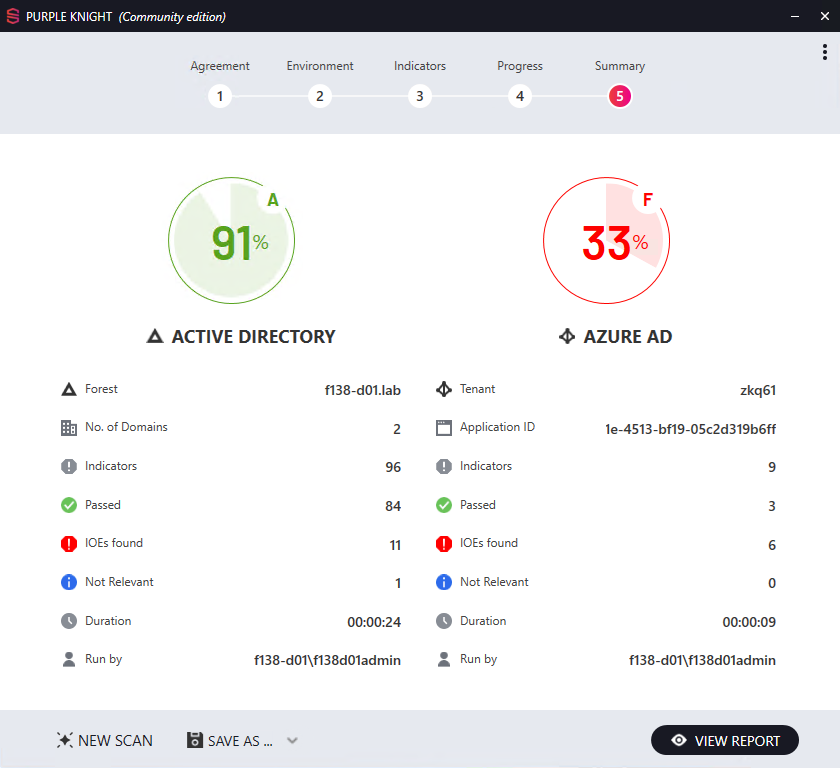
Semperis Purple Knight is a free security assessment tool for on-premises Active Directory, Entra ID, and Okta. It scans on demand and returns a scored report card with remediation guidance.
Source: semperis.com
What stands out
- A report card groups findings into five categories with an overall score and remediation guidance.
- Indicators map to MITRE ATT&CK and the French national cybersecurity agency's (ANSSI) framework, plus a likelihood-of-compromise rating.
- Scoring weighs indicator severity against how many objects are affected, not just a raw pass/fail count.
- The tool never modifies Active Directory; it only runs read-only PowerShell and LDAP queries to produce its findings.
What to consider
- On-demand, manual scans leave directory drift invisible between runs and require a paid Semperis product or custom automation for scheduled scanning and a combined multi-forest view.
- A brand-new domain with no customizations or legacy delegations still returns findings, so treat the first score as a floor, not a clean bill of health.
- Some scans need enough access to run PowerShell and LDAP queries over RPC, and every fix still lands on an administrator with enough Active Directory depth to read a finding like a risky delegation correctly.
- Published indicator totals have grown with product updates, so raw counts don't compare cleanly across versions.
Best for: Teams needing a free scored baseline with in-house Active Directory expertise.
Tenable One Identity Exposure
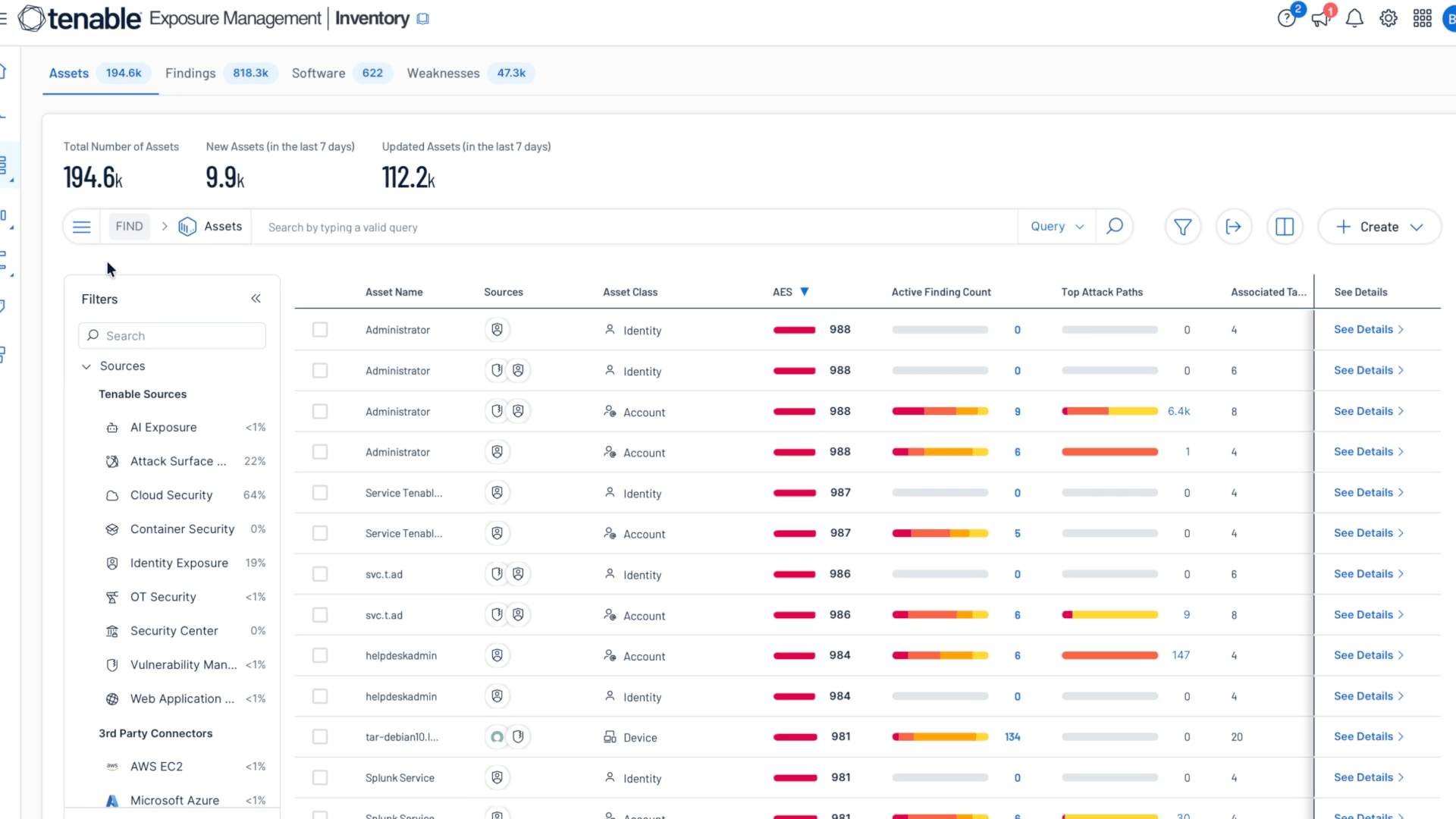
Tenable One Identity Exposure is a licensed identity security posture management (ISPM) platform for Active Directory and Entra ID, formerly Tenable.ad and then Tenable Identity Exposure. It runs two engines. One continuously flags exposures across both directories, and the other detects live attacks in real time.
Source: tenable.com
What stands out
- The exposure engine continuously flags misconfigurations across Active Directory and Entra ID.
- The attack engine detects 17 documented Active Directory techniques in real time, including DCSync, DCShadow, Kerberoasting, Golden Ticket, password spraying, and brute-force password guessing.
- Identity 360 unifies human and machine identities across both directories with risk ranking, remediation scripts and attack path analysis showing how an attacker could reach a target asset.
- Alerts forward over syslog in Common Event Format to collectors including Splunk, IBM QRadar, and ArcSight.
- Deployment runs as SaaS or a customer-managed on-premises install, connecting agentlessly with a regular user account and no administrative permissions.
What to consider
- Quote-based licensing and an enablement step add procurement time before the first finding arrives.
- The attack engine detects in real time only within Active Directory; the exposure engine covers Entra ID, but the attack engine does not.
- Three carve-outs sit outside that agentless model. The Group Policy Object feeding the attack engine needs administrative credentials, the Kerberoasting indicator depends on a honey account, and privileged analysis requires elevated rights.
- Identity-only deployments forfeit the cross-surface features that justify the platform's price, including Exposure Signals, Exposure View, and the platform-level Attack Path.
- Okta support inside Identity 360 looks narrower than Tenable's native Active Directory and Entra ID monitoring, so Okta-centric teams should confirm the exact scope before signing.
Best for: Organizations with staffed security operations routing identity alerts into a SIEM.
Purple Knight and Tenable One Identity Exposure head-to-head
How often each tool scans the directory determines its detection depth, its cost, and what it can prove to an auditor.
Assessment cadence
Purple Knight captures the directory as it stood the moment someone ran the scan. If a privileged group changes the next morning, or a Group Policy Object modification the next month, it stays invisible until the next run, and catching it then depends on an administrator diffing two reports by hand. Tenable maintains a running baseline instead and alerts on those same changes as they land, without waiting for the next scheduled scan.
Threat detection depth
Purple Knight's compromise evidence surfaces after the fact, proof that something already happened, sometimes discovered weeks later on the next scan. Tenable's attack engine can fire while an attack such as DCSync is still running, when interrupting it is still possible. Neither approach clears the underlying misconfiguration backlog on its own, and both tools leave that queue to whoever owns the directory.
Cost and time to first finding
Purple Knight costs nothing and needs no purchase order, so a scored report can land the same day someone decides to run one. Tenable licenses per enabled identity on a quote basis and doesn't activate Identity Exposure automatically, even for existing Tenable One customers. Procurement and enablement therefore come before the first finding.
The more useful measure is time to a working operating rhythm, because a scored report nobody schedules and an alert stream nobody watches produce the same outcome. Teams should price the staffing model alongside the license.
Evidence that a fix held
Auditors do not accept a single date as proof that a control worked. A SOC 2 operating-effectiveness test asks for evidence across the whole review period, and IT general controls testing traces each sampled change from request through approval to closure.
Purple Knight's scan proves a control passed on the scan date, and Tenable's alert proves the platform saw an attack. Neither provides the before-and-after record showing a flagged exposure was remediated and stayed remediated, which continuous auditing guidance asks teams to maintain across the observation window.
Purple Knight answers where the directory stands today, Tenable One Identity Exposure answers what is happening in it right now, and neither answers whether last quarter's fix is still in place.
How to choose between Purple Knight and Tenable One Identity Exposure
The choice depends on what the next 90 days need to deliver, and the two tools excel at genuinely different things.
Choose Purple Knight if:
- Okta runs as a core directory alongside Active Directory and Entra ID, and posture coverage has to reach all three.
- Leadership needs a scored, framework-mapped report this week and procurement would take longer than the remediation.
- The team has Active Directory depth in-house, and the work ahead is a backlog of misconfigurations with no active incident.
Choose Tenable One Identity Exposure if:
- Someone is on shift to act on identity alerts, and those alerts need to land in an existing SIEM.
- Live detection of Active Directory attack techniques matters more than breadth across non-Microsoft identity providers.
- A broader Tenable One deployment already enables cross-surface exposure features.
For lean teams without a dedicated security operations function, alert capacity decides the choice before feature depth does. A detection platform needs someone to watch and act on its output to earn its license. Scheduled assessments or a managed detection and response provider often fit better than detection nobody has time to triage.
When to choose Netwrix over Purple Knight or Tenable One Identity Exposure
Netwrix has no single product that replaces either tool. Netwrix PingCastle is the like-for-like match for Purple Knight, Netwrix Threat Prevention and Netwrix Threat Manager cover the live-attack work Tenable's attack engine does, and Netwrix Auditor supplies the change record neither tool produces.
When the team needs a free, repeatable assessment instead of a one-time scan
Netwrix PingCastle scores Active Directory risk against 170-plus MITRE ATT&CK-mapped checks and identifies misconfigurations, attack paths, and privilege exposure. The tool is free, so a second or third assessment costs nothing beyond the time to run it, and it delivers a prioritized remediation roadmap. Teams that re-run it on a set rhythm narrow the window a single annual scan leaves open.
When detection needs to turn into blocking, not just an alert
Netwrix Threat Prevention blocks DCSync, Kerberoasting, and pass-the-hash attempts on Active Directory in real time, before they succeed. For teams that already run detection, Netwrix Threat Manager covers identity threat detection across credential theft, lateral movement, and privilege escalation. It added Active Directory Certificate Services misconfiguration techniques ESC1 through ESC7 at the end of April 2026.
AppRiver uses Netwrix Auditor to get alerts on critical Active Directory and Group Policy changes as soon as they happen, and it can return to the previous state in just five minutes across 250 users in six domains.
When the evidence has to prove a fix held, not just that it happened once
Netwrix Auditor records every Active Directory and Entra ID change with who, what, and when context, plus before-and-after values. The trail is searchable and survives the observation period.
Its predefined reports map to SOX, HIPAA, PCI DSS, and GDPR, so Active Directory change-auditing evidence comes from the trail, not screenshots. When an examiner samples a remediated exposure, the chain from change to closure is already recorded.
With Netwrix Auditor, First National Bank and Trust of Beloit can prepare for Office of the Comptroller of the Currency (OCC) audits in one hour instead of one week.
Product separation carries its own cost. Covering assessment, detection, blocking, and audit evidence means scoping deployment, licensing, and ownership for each. Netwrix coverage also runs deepest in Microsoft directories, so Okta-centric organizations should validate fit before purchase.
Matching the tool to the operating model
Purple Knight versus Tenable One Identity Exposure is a cadence decision before it is a feature decision. Neither tool shows whether a remediation held across the entire review period, which is the sample an examiner is most likely to draw.
Price the operating model each option commits the team to, then pick the job that matters most over the next two quarters.
Request a demo to see how Netwrix PingCastle and Netwrix Auditor turn a free assessment into evidence of a control held against your own directory.
Disclaimer: Information in this article was verified as of October 2026. Verify current capabilities directly with each vendor.
Frequently asked questions about Purple Knight vs. Tenable One Identity Exposure
Share on
Learn More
About the author

Netwrix Team
Learn more on this subject
Netwrix Innovation Week: 1Secure™ with Agentic AI security
Bring Your Own Vault: Why "rip and replace" isn't the only option
Beyond the vault: Zero standing privilege defeats more than password attacks
The password was never the only problem: Legacy PAM vs. modern PAM
Netwrix Innovation Week: Why agentic AI security matters