
Semperis vs. Quest: Comparing Active Directory protection platforms
Aug 4, 2026
Losing Active Directory to ransomware or a privilege-escalation chain halts every system that authenticates against it. The platform choice comes down to recovery depth versus modular breadth: one approach couples detection and forest recovery tightly, while the other assembles detection, recovery, auditing, and governance as separate purchases. The wrong fit splits incident response and audit evidence across tools a lean team can't operate.
Seventy-five percent of sensitive data exposures begin with compromised identities or misconfigured permissions, according to The Netwrix 2026 Data and Identity Security Report. Active Directory concentrates that risk: when the directory falls, detection, recovery, and audit evidence all depend on the platform protecting it.
Most Semperis vs. Quest evaluations now bundle those needs into one buying decision. Semperis concentrates on identity threat detection and response (ITDR) and recovery in Directory Services Protector (DSP) and Active Directory Forest Recovery (ADFR).
Quest spans a wider portfolio: Identity Defense for ITDR, Recovery Manager for Active Directory (RMAD) and Identity Recovery for Microsoft Entra ID for recovery, plus Change Auditor and Active Roles for auditing and governance.
This comparison weighs detection, recovery depth, evidence of compliance, and operational effort.
Semperis vs. Quest vs. Netwrix at a glance
Dimension | Semperis | Quest | Netwrix |
|---|---|---|---|
|
ITDR and threat detection |
DSP: replication-stream monitoring, rollback of malicious changes, machine learning detection of password spray and credential stuffing |
Identity Defense: alerts on attacker techniques across AD and Entra ID, Shields Up containment for Tier 0 assets |
Netwrix Threat Manager detects credential theft and lateral movement; Netwrix Threat Prevention blocks DCSync, Kerberoasting, and Pass-the-Hash before they succeed |
|
Recovery |
ADFR: forest recovery with Clean Restore and Anywhere Recovery; DRET covers Entra ID tenants as a separate SaaS product |
RMAD: granular and forest-level backup and recovery; Identity Recovery for Entra ID as the cloud counterpart |
Netwrix Identity Recovery covers AD objects, forests, Entra ID, and Okta recovery |
|
Governance and compliance evidence |
DSP includes compliance report templates for GDPR, HIPAA, PCI DSS, and SOX; access governance requires supplemental tooling |
Framework-mapped reporting lives in Change Auditor and Active Roles, separate from Identity Defense and RMAD |
Netwrix Auditor pairs before-and-after change values with reports pre-mapped to SOX, HIPAA, PCI DSS, GDPR, and FISMA/NIST, while Netwrix Access Analyzer handles access reviews |
|
Attack path analysis |
DSP and ADFR do not position attack path analysis as a core feature |
Available through SpecterOps BloodHound Enterprise as a distinct product |
Identity security posture management runs 170+ risk checks mapped to MITRE ATT&CK and surfaces attack paths |
|
Console and portfolio model |
Tighter DSP and ADFR integration; Lightning Intelligence and DRET are separate SKUs |
Modular by design; no confirmed single console across the portfolio |
One vendor relationship across Threat Prevention, Threat Manager, Auditor, and Identity Recovery |
|
Best for |
Recovery-first enterprises with AD and Entra ID risk |
Modular buyers with the capacity to run several Quest tools |
Mid-market, Microsoft-heavy, regulated teams consolidating detection, evidence, and recovery |
Netwrix Threat Prevention blocks AD attacks such as DCSync, Kerberoasting, and Pass-the-Hash at the domain controller before they succeed. Request a demo.
Why buyers compare Semperis and Quest
The two vendors reach the same shortlist through different doors, and a pair of platform shifts is accelerating the comparison.
Recovery and ITDR are becoming one buying decision
Organizations used to buy backup and detection tools separately. Semperis now positions DSP and ADFR together, while Quest lists Identity Defense, RMAD, and Identity Recovery for Entra ID as separate offerings across identity security and recovery. Buyers evaluating AD protection increasingly want a single vendor relationship that covers both detection and recovery.
Quest's portfolio breadth raises the one-console question
Quest's Identity Defense, RMAD, and Change Auditor are separate offerings, and attack path analysis may require SpecterOps BloodHound Enterprise as an additional purchase. An attack path shows how an attacker could move from one exposed identity, permission, or system to a more valuable target. Modularity lets teams buy precisely what they need, yet console sprawl carries a visibility cost.
Semperis's tighter integration comes with its own trade-off
Semperis DSP and ADFR integrate more tightly than Quest's product line does. The broader Semperis stack still spans multiple stock-keeping units (SKUs): Lightning Intelligence handles posture assessment as a separate SaaS offering, and Disaster Recovery for Entra Tenant (DRET) covers Entra ID tenant recovery as a standalone SaaS product.
Quest's new FedRAMP High authorization changes regulated evaluations
Quest announced FedRAMP High authorization for Identity Defense and Identity Recovery for Entra ID in Microsoft Azure Government in July 2026. For defense contracting, healthcare, and public-sector buyers, that credential matters when the exact product, tenant, and deployment model match the requirement, so confirm scope during procurement.
Semperis: Integrated ITDR and forest recovery
Semperis centers its platform on DSP for hybrid AD and Entra ID threat detection and ADFR for cyber-resilient recovery, with Lightning Intelligence and DRET extending coverage as separate SaaS products. Its differentiator is recovery depth: Clean Restore and Anywhere Recovery are built to prevent malware reintroduction during a forest rebuild.
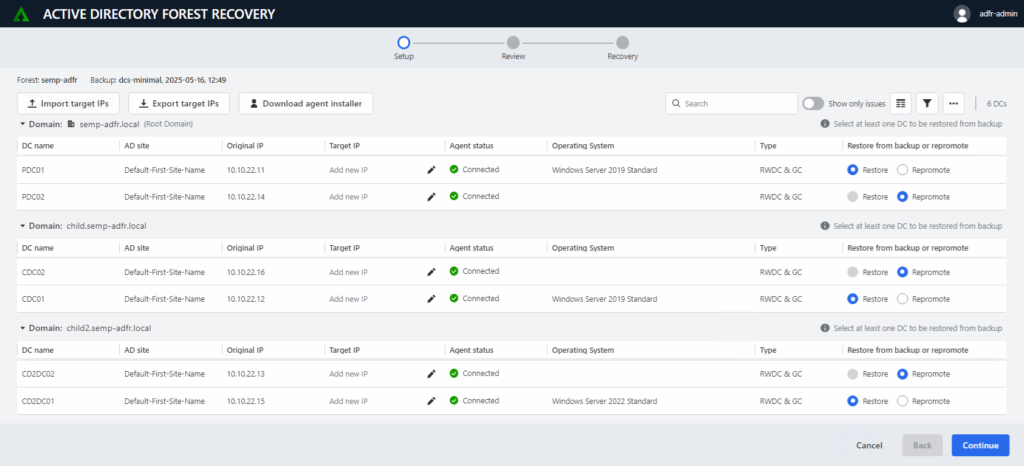
Sources: semperis.com
DSP monitors the Active Directory replication stream, which Semperis positions as a tamperproof data source: an attacker who disables Windows event logs or removes agents can't bypass detection that reads replication data directly.
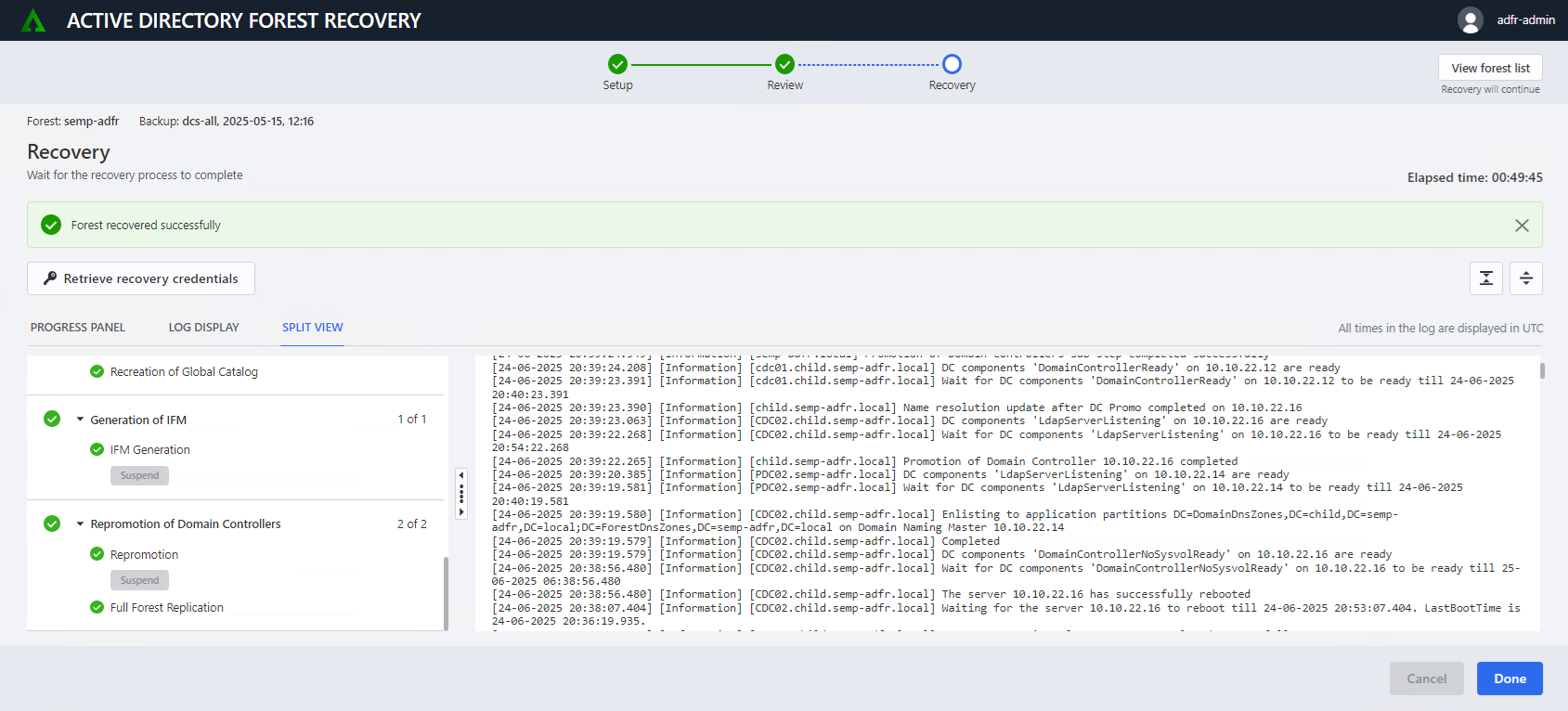
Sources: semperis.com
What stands out:
- Replication-stream monitoring with tamperproof change tracking and Auto Undo rollback across on-premises AD and Entra ID.
- Identity Runtime Protection with machine-learning models for password spraying, credential stuffing, and brute-force detection.
- ADFR automation is tied to shorter forest recovery timelines in a Semperis-commissioned Forrester Total Economic Impact study.
- Anywhere Recovery coverage for physical, virtual, on-premises, and cloud infrastructure, including alternate IP address spaces.
- Native DSP compliance report templates for GDPR, HIPAA, PCI DSS, and SOX evidence collection.
- Ready1 packaging that combines ADFR, DRET, and incident response services for eligible customers.
What to consider:
- DSP detects and rolls back changes after a commit, so teams that need pre-execution blocking should test compensating controls.
- Replication-stream visibility may miss LDAP queries, Kerberos authentication, and reconnaissance events that lack replication metadata.
- Continuous access governance and entitlement reviews require additional tooling beyond the DSP compliance templates.
- Semperis's public materials do not confirm a Cybersecurity Maturity Model Certification (CMMC) mapping, which affects defense contractor audit planning.
- Full coverage across DSP, ADFR, Lightning Intelligence, and DRET requires multiple licenses, increasing procurement and renewal workloads.
- Coverage centers on AD and Entra ID, so Okta and non-human identities require supplemental controls.
Best for: Recovery-first enterprises with AD and Entra ID risk.
Quest: Modular recovery, detection, and governance
Quest addresses AD protection through a modular portfolio: Identity Defense (formerly Security Guardian) for ITDR, RMAD and Identity Recovery for Entra ID for backup and recovery and Change Auditor and Active Roles for auditing and governance.
Its differentiator is the ability to assemble detection, recovery, auditing, governance, and attack-path mapping as separate purchases, each aligned with specific operating needs.
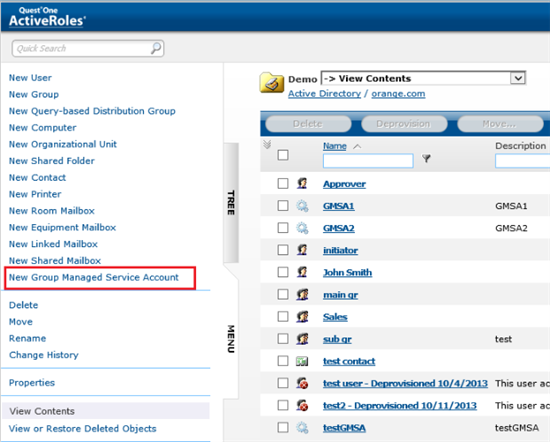
Source: quest.com
Quest positions Identity Defense for alerts on attacker tools and techniques across AD and Entra ID, Tier 0 drift visibility, and Shields Up containment. Tier 0 refers to the most privileged identity assets, such as domain controllers and accounts that can control the directory.
Quest describes Shields Up as an overlay that does not modify AD permissions, which makes it easy to apply and remove during an active incident, while protocol-layer blocking remains a separate proof-of-concept requirement.
What stands out:
- Identity Defense alerts across AD and Entra ID with Shields Up containment for crown-jewel identity assets.
- Continuous identity posture benchmarking that surfaces Tier 0 exposures and non-human identity vulnerabilities.
- Group Policy Object and directory information tree indicators that help prioritize directory-risk investigation.
- RMAD forest-level disaster recovery with granular object and attribute restore options.
- Identity Recovery for Entra ID, the cloud directory counterpart to RMAD, is now FedRAMP High-authorized in Azure Government.
- SpecterOps BloodHound Enterprise attack-path mapping is available as a separate product.
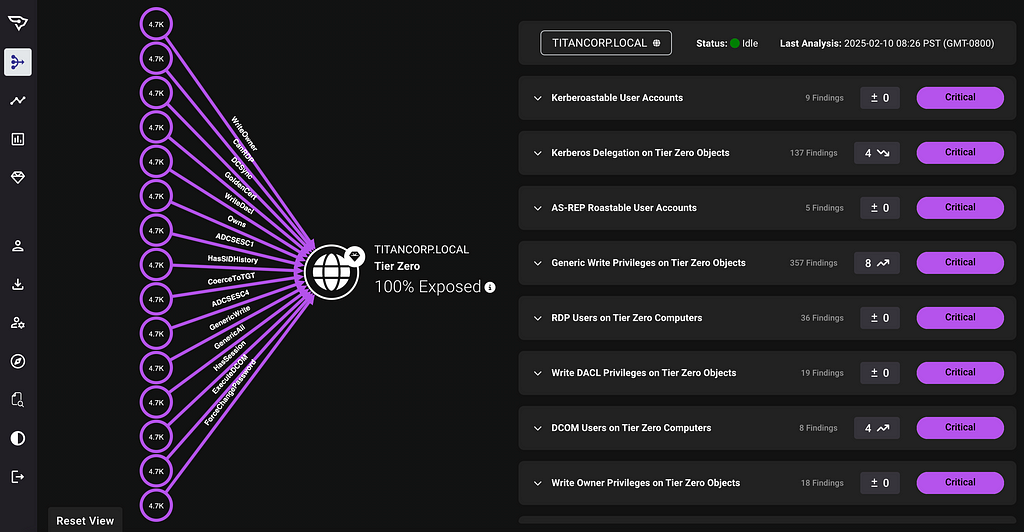
What to consider:
- Quest does not confirm a single console across the Identity Defense, RMAD, Identity Recovery, and Change Auditor workflows.
- Attack path analysis comes through BloodHound Enterprise, so evaluate licensing and remediation handoffs separately.
- Full governance coverage requires Change Auditor, Active Roles, or comparable tooling to increase operational ownership.
- Shields Up is an overlay rather than a protocol-layer blocking, so test it against active-incident requirements.
- Identity Defense markets audit readiness, while framework-mapped templates live in separate auditing and governance products.
Best for: Modular buyers with the capacity to run several Quest tools.
Semperis vs. Quest: Head-to-head comparison
The criteria below cut across both vendors' multi-product portfolios rather than comparing single SKUs in isolation.
Threat detection approach
Semperis DSP detects malicious changes through replication-stream monitoring and rolls them back with Auto Undo after commit. That design gives tamperproof change visibility, though LDAP query, Kerberos authentication, and reconnaissance coverage need validation. Quest Identity Defense adds Shields Up containment, freezing changes to crown-jewel assets mid-attack, an overlay that sits outside protocol-layer blocking. Quest edges ahead on containment speed.
Recovery depth and recovery time objective (RTO)
Semperis ADFR is built around Clean Restore and Anywhere Recovery to prevent malware reintroduction during a rebuild. Quest RMAD offers granular object and attribute restore without a full domain controller rebuild and automates Microsoft forest recovery practices.
Semperis leads on catastrophic forest-recovery design; Quest leads on granular, targeted restores. Test the actual RTO for your scenario in a proof of concept rather than taking either claim at face value.
Governance and compliance evidence
Semperis DSP includes compliance report templates for GDPR, HIPAA, PCI DSS, and SOX, without continuous access governance or entitlement review. Quest splits forensic change tracking into Change Auditor, a separate purchase from Identity Defense. For Department of Defense (DoD) contractors working against CMMC deadlines, framework-mapped evidence and access reviews directly affect audit readiness.
Semperis leads in out-of-the-box templates within its core ITDR product; Quest requires an additional purchase for the equivalent. Both need supplemental tooling for continuous access governance.
Console and portfolio complexity
Semperis integrates DSP and ADFR tightly but sells Lightning Intelligence and DRET separately. Quest is modular by design, with no confirmed single console across Identity Defense, RMAD, Identity Recovery for Entra ID, Change Auditor, and BloodHound Enterprise.
Neither vendor offers a single console that covers detection, recovery, and governance. That gap makes a side-by-side proof of concept with a consolidated alternative worth running.
How to choose between Semperis and Quest
Both vendors protect the same directory, so the choice typically follows the failure mode that would cause the most harm.
Choose Semperis if:
- The priority is the fastest, most reliable full-forest recovery after a catastrophic event.
- Tamperproof, replication-based change tracking with automated rollback fits your detection model.
- The team prefers tighter DSP and ADFR integration and can budget for Lightning Intelligence and DRET as coverage grows.
Choose Quest if:
- The priority is to assemble the detection, recovery, auditing, and attack-path mapping modules, module by module.
- Granular object and attribute restoration matters more day-to-day than full forest rebuild speed.
- FedRAMP High authorization in Azure Government is a hard requirement for Entra ID protection and recovery.
The tie usually breaks on operating capacity: a smaller team may prefer fewer, tighter products, while a team that wants separate tools per function and can manage several consoles may prefer modularity.
When to choose Netwrix over Semperis or Quest
For mid-market organizations (100-5,000 employees) in regulated industries with Microsoft-heavy environments, the practical question is whether the team can consolidate AD recovery, blocking, audit evidence, and access reviews without adding another operational silo.
When you need real-time blocking, beyond detection or rollback
Both compared platforms emphasize rollback or containment after detection. Netwrix Threat Prevention blocks DCSync at the domain controller itself by intercepting the GetNCChanges API call when a machine outside the policy scope invokes it. Test other privileged-change prevention requirements, such as group membership changes and Group Policy Object edits, during a proof of concept.
When you need access reviews with compliance report templates
Core ITDR products often leave continuous access governance to supplemental tooling, and standing access is exactly where that gap bites: The Netwrix 2026 Data and Identity Security Report found 76% of organizations can't immediately revoke standing access.
Netwrix Auditor pairs before-and-after AD change auditing with reports pre-mapped to SOX, HIPAA, PCI DSS, GDPR, and FISMA/NIST, and integrates with Access Reviews, enabling business owners to review resources and groups alongside auditing.
The audit-efficiency payoff is concrete in financial services: First National Bank and Trust of Beloit cut Office of the Comptroller of the Currency (OCC) audit preparation from one week to one hour with Netwrix Auditor.
When you want forest recovery from the same vendor as detection and auditing
Netwrix Identity Recovery rolls back individual objects, attributes, and group memberships from the change timeline and automates full AD forest recovery, covering AD, Entra ID, and Okta under the same vendor relationship as Netwrix Threat Prevention, Netwrix Threat Manager, and Auditor. Run a side-by-side RTO comparison during a proof of concept rather than taking any vendor's recovery speed claim at face value.
Teams that need blocking, audit evidence, and directory recovery to run as a single operational model get all three from a single Netwrix deployment, rather than assembling them across separate consoles and licenses.
Request a demo to see how Threat Prevention, Auditor, and Identity Recovery handle blocking, audit evidence, and forest recovery side by side with your Semperis or Quest shortlist.
Disclaimer: The information in this article was verified as of July 2026. Product capabilities, roadmaps, and pricing may change; verify directly with each vendor before procurement.
Frequently asked questions about Semperis vs. Quest
Share on
Learn More
About the author

Netwrix Team
Learn more on this subject
Microsoft is retiring memberOf operator in Entra ID Dynamic Groups. What should administrators do next?
Powerful LDAP extended controls: Anti-remediation and invisible recon in AD
Create AD Users in Bulk and Email Their Credentials Using PowerShell
How to create, change, and test passwords using PowerShell
How to Add and Remove AD Groups and Objects in Groups with PowerShell