
You only need AI tokens to become a hacker
Oct 23, 2026
AI has removed the skill, personalization, and speed barriers that once limited cyberattacks. Attackers use language models at every stage of the kill chain, from recon to persistence, and underground tools sell pre-jailbroken access to mainstream models for as little as $50 a week. But because every attack still has to change a file, a configuration, or a script on a real system, detecting unplanned change works no matter which model wrote the payload.
Public code repositories are already full of attack scripts. Underground AI tools generate phishing lures and functional malware on demand, so access to a model's API is about all that stands in the way. With the skill requirement nearly at zero, expect more attacks to reach your inbox, your help desk, and your login page. Which model sits behind an attack is also becoming a more useful threat signal than who ran it.
Three barriers AI removed
Skill. Writing malware used to mean knowing a programming language, understanding how antivirus signatures work, and testing code until it ran. Now an attacker describes what they want in plain English and a model writes it. Phishing works the same way. The model already knows what makes a message feel legitimate, urgent, and safe to click, so the attacker doesn't need to write persuasive copy.
Personalization. Old-school phishing blasted thousands of generic emails and hoped a few percent clicked. Feed a model someone's LinkedIn profile, a company press release, and a few social posts, and it writes a lure that cites their real job title, their manager's name, and their vendor relationships. A skilled social engineer needed hours to research one target. A model needs seconds, and it can work through an entire target list at once.
Speed. Traditional defenses rely on patterns: malware signatures, known phishing domains, and behavioral baselines. AI-generated attacks mutate faster than anyone can catalog those patterns. By the time a signature exists for one version, the model has produced ten more that don't match it.
Together, these changes blur the line between a script kiddie and a serious threat actor.
How AI changes the attack kill chain
The kill chain itself looks the same. The scale is what changed.
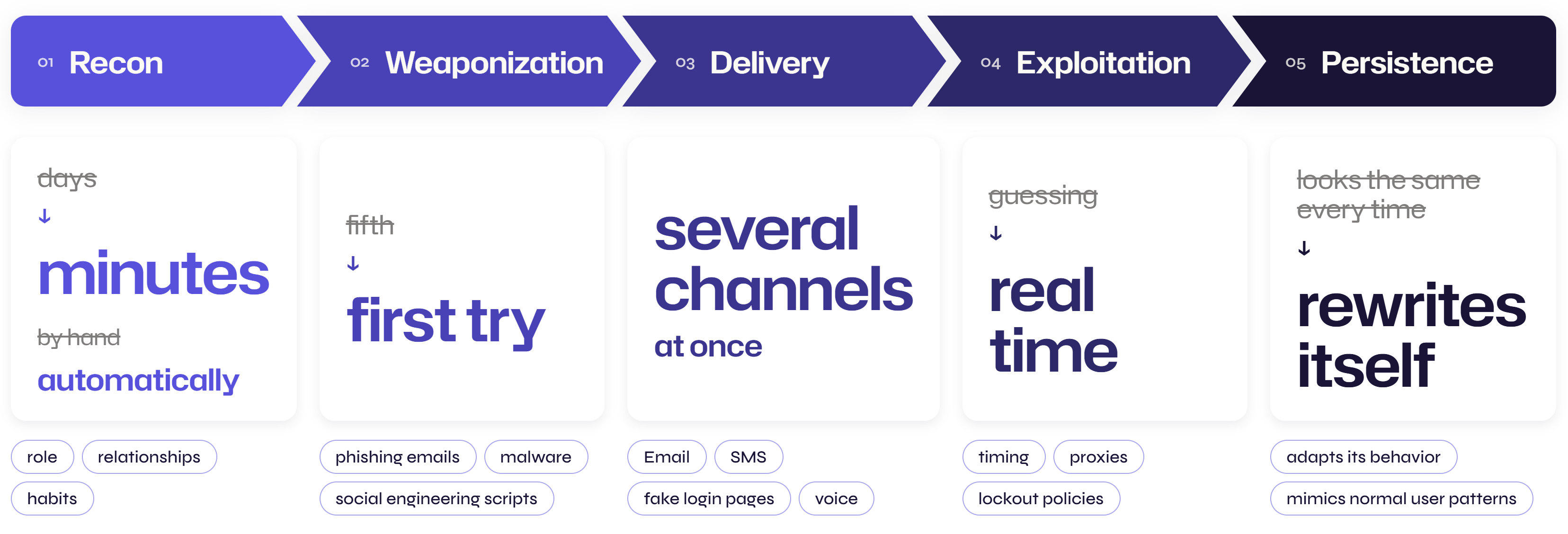
- Recon. Attackers used to dig through LinkedIn, company directories, and old data breaches by hand. AI tools now scrape and cross-reference that data automatically, building a profile of a target's role, relationships, and habits in minutes instead of days.
- Weaponization. The model writes the attack material, including phishing emails tuned to a specific tone, malware that works on the first try instead of the fifth, and social engineering scripts that match how a department talks internally.
- Delivery. Attackers reach targets through email, SMS, fake login pages, and voice. Generation is cheap, so they hit several channels at once and see what lands.
- Exploitation. Once there's a foothold, through stolen credentials or a vulnerability, AI helps automate the next moves. It optimizes timing, rotates through proxies, and adjusts to lockout policies in real time instead of guessing.
- Persistence. Static malware gets caught because it looks the same every time. AI-assisted malware rewrites itself, adapts its behavior, and mimics normal user patterns while it quietly moves data out.
AI touches all five stages, which sets this wave apart from earlier cybercrime tooling.
Which AI models attackers use, and for what
Mainstream models like ChatGPT, Claude, Gemini, and Grok ship with safety guardrails, so attackers put real effort into jailbreak prompts and prompt injection to get output the model shouldn't produce. The payoff is quality. These are the most capable models on the market, so a successful jailbreak returns top-quality results.
Then there's the underground tier: WormGPT, FraudGPT, and GhostGPT. Despite the "evil" reputation, many of these are thin wrapper services: a chat interface and a jailbreak-tuned system prompt sitting on top of legitimate models like Grok or Mixtral. Buyers get a model that's already jailbroken, so they skip that work themselves.
Use cases split along capability lines. Strong coding models handle malware and exploit generation, because output quality decides whether the payload works. Strong conversational models handle phishing and business email compromise (BEC), because tone and context make a lure convincing. As voice and video generation improve, expect more deepfake-assisted vishing, including fake voicemails and video calls from a "vendor" or a "manager" asking for a wire transfer.
Attackers are model-shopping, choosing the strongest tool for each stage of the kill chain the way a developer reaches for the right tool for the job.
The economics of AI-driven attacks
Every prompt and every generated output carries a real dollar cost on the backend, whether the attacker uses a legitimate API or a criminal wrapper service. Pricing for the underground tools is public by now. Telegram-based options start around $50 a week, and more established services run about $200 a month, or close to $1,700 a year.
Compare that to the payout. One successful BEC attack can net tens of thousands of dollars in a single wire transfer, and a ransomware deployment can be worth far more. Against that upside, $200 a month is a rounding error. AI makes attacks cheap to build and profitable at a volume that didn't exist five years ago.
How Netwrix Change Tracker catches what AI-built attacks leave behind
Every stage of the kill chain, from weaponizing a payload to persisting on a system, eventually touches something real: a file, a config setting, a script, or a registry key. AI can make an attack faster and harder to spot by eye, but that last step stays visible. Netwrix Change Tracker flags a change the moment it happens, checks it against what's planned and approved, and keeps a full record of what moved, when, and whether it matched policy. It treats a change from a junior sysadmin, a $50-a-week script kiddie, and a jailbroken model working at scale the same way.
The same logic covers the AI systems your own organization runs. You can't watch a model's behavior directly, but the system prompts, safety filters, and configuration files that govern it live on servers, and Change Tracker can monitor them.
The attacker's toolkit changes every week, but detection built on what your systems are supposed to look like doesn't need to keep pace. It only needs to notice when they differ.
See Change Tracker in actionExplore every Innovation Week conversation to hear Netwrix and industry experts discuss data and identity security.
Share on
Learn More
About the author

Dan Piazza
Manager of Product Management
Dan Piazza is a Manager of Product Management at Netwrix, responsible for multiple Endpoint, DSPM, and Directory products. He has worked in technical roles since 2013, with a passion for cybersecurity, data protection, automation, and code. Prior to Product Management, he's worked in Systems Engineering, Quality Assurance, and Technical Support.
Learn more on this subject
What is remote code execution (RCE)? How AI speeds up exploitation and how to limit the damage
Netwrix Innovation Week: Identity security innovations
What is DLL hijacking, and why your new AI plugin might be the easiest way in
The AI jailbreak problem isn't going away, and compliance frameworks need to catch up
Automating Entra ID tenant destruction with AI