
8 best data discovery and classification tools in 2026
Jun 17, 2026
Data discovery and classification platforms distinguish themselves across three dimensions: hybrid versus cloud-only coverage, whether classification ties to identity and permissions context, and whether the tool drives remediation or simply applies labels. Tools that connect discovery and classification to identity and downstream enforcement turn visibility into measurable risk reduction.
Most organizations struggle to locate all sensitive data across their infrastructure, the core challenge these tools address. Research from Harmonic Security's Q3 2025 analysis found that 26.4% of files uploaded to GenAI tools contained sensitive data, up from 22% the previous quarter.
That number only tells half the story. A file's sensitivity doesn't set its risk on its own; who or what already has permission to reach it does. The Netwrix 2026 Data and Identity Security Report found that 74% of organizations lack a single unified view of where sensitive data resides and which identities can access it, and only 26% can answer that question today. Finding sensitive data and knowing who can reach it are a single problem to solve together.
The best tools answer both questions at once. This guide compares eight data discovery and classification solutions across hybrid, cloud-first, privacy, and endpoint scenarios.
The 8 best data discovery and classification tools at a glance
The table below lines up deployment model, primary focus, and best-fit use case for all eight tools.
Vendor | Primary focus | Deployment | Best for |
|---|---|---|---|
|
Netwrix Data Classification |
Identity-aware classification |
SaaS, on-premises, hybrid |
Hybrid, Microsoft-centric environments needing classification tied to identity and access governance |
|
Microsoft Purview Information Protection |
Native Microsoft 365 labeling |
Cloud (Microsoft 365, Azure) |
Organizations standardized on Microsoft 365 and Azure |
|
Varonis Data Security Platform |
Behavioral analytics on unstructured data |
SaaS (on-prem reaching EOL Dec 2026) |
Unstructured file data and collaboration platforms |
|
BigID |
Privacy-anchored data intelligence |
Hybrid, cloud |
Enterprise privacy and compliance teams managing multi-framework obligations |
|
Sentra |
Cloud-first, agentless DSPM |
Cloud (multi-cloud) |
Cloud-first organizations needing agentless discovery with data movement visibility |
|
Cyberhaven |
Data lineage and detection/response |
Endpoint, cloud, SaaS |
Intellectual property protection and insider risk where data movement matters most |
|
Securiti |
Unified privacy and security posture |
Cloud, SaaS, on-premises |
Discovery and classification connected to privacy operations and security posture |
|
Spirion Sensitive Data Platform |
Endpoint-first discovery |
Endpoint (workstations, servers) |
Regulated healthcare and financial services with endpoint-heavy exposure |
Deployment model narrows the field fast, but it doesn't say whether a tool actually reduces risk once it's running. The criteria below separate a tool that just inventories sensitive data from one that helps you act on it.
What to look for in data discovery and classification tools
Finding sensitive data is only the first step; acting on the findings reduces actual risk. Six criteria distinguish tools delivering measurable outcomes from those producing shelf-ready reports:
- Hybrid and cloud coverage breadth: Verify the tool covers your actual data stores, as cloud-focused scanners frequently omit on-premises file servers, network-attached storage (NAS), on-premises SharePoint, and legacy databases containing regulated information.
- Classification accuracy and trainable classifiers: Validate accuracy using a proof of concept on your own data, and confirm classifiers adapt to custom data types and region-specific identifiers beyond standard templates for PII, PHI, and PCI. A checklist for improving classification accuracy helps structure that proof of concept before you run it.
- Automated versus manual classification method: Confirm whether classification runs on pattern matching, machine learning, or manual end-user tagging, since manual-only approaches leave coverage gaps wherever employees skip or mislabel files.
- Identity and permissions context: Choose tools that connect classification to access permissions, since isolated sensitive file lists can't be acted on and leave data access governance gaps unaddressed.
- Remediation and downstream enforcement: Select platforms driving owner reviews, quarantine, permission changes, and data loss prevention or label propagation, because classification-only tools leave the risk in place.
- AI and shadow AI data governance: Verify whether the tool surfaces sensitive data flowing into generative AI tools and Copilot.
Netwrix Data Classification software discovers and tags PII, PHI, and PCI data across hybrid stores. Download a free trial
8 best data discovery and classification tools in 2026
Each profile below covers what the tool does, its standout features, real limitations, and who it fits best, starting with the platforms offering the broadest hybrid and identity-aware coverage and moving toward tools built for more specific environments, cloud-first, endpoint-first, or privacy-anchored.
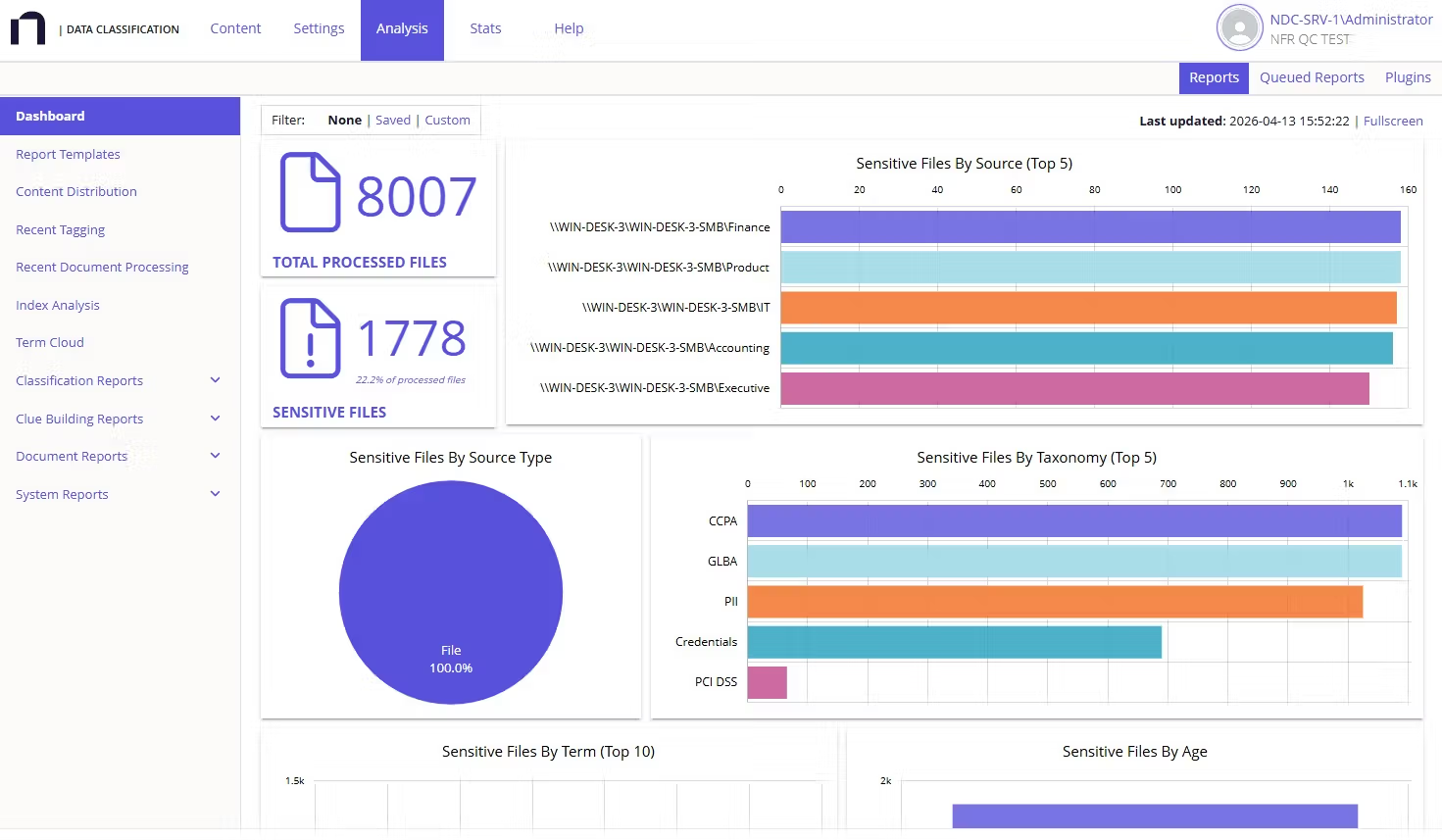
1. Netwrix Data Classification
Netwrix Data Classification is an identity-aware data discovery and classification platform that discovers and tags PII, PHI, PCI data, and custom data types across file servers, NAS, Microsoft 365, and cloud storage. It then feeds those results into identity-aware security decisions through the broader Netwrix platform, connecting where sensitive data lives to who can access it.
Source: netwrix.com/
Key features:
- Hybrid and cloud discovery: Scans file systems, databases, email, and cloud repositories, using compound term processing and statistical analysis rather than keyword matching alone.
- ROT data identification: Flags redundant, obsolete, and trivial data alongside sensitive data, so cleanup and risk reduction happen in the same pass.
- Direct remediation actions: Moves sensitive files to secure locations, removes excessive permissions, and redacts confidential content, all in agentless mode.
- Pattern, contextual, and AI-driven classification: Predefined and custom taxonomies classify content, with compliance reports aligned to GDPR, HIPAA, and PCI DSS.
- Microsoft Information Protection labeling: Applies MIP labels directly to documents, so classification travels with the file into other Microsoft security tools.
- DLP and IRM enhancement: Embeds classification metadata into files, strengthening enforcement in downstream data loss prevention and information rights management tools.
What to consider:
- Coverage is deepest in Microsoft-centric hybrid estates, so AWS-native or GCP-first teams should validate connector depth during evaluation.
- Cloud-native data stores outside Microsoft 365 need Netwrix DSPM alongside Netwrix Data Classification for complete estate coverage.
- Data Classification itself doesn't show which identities can reach a flagged file. That requires pairing with Netwrix Access Analyzer, which resolves effective access back to AD and Entra ID group memberships.
In practice, the discovery-to-remediation connection shows up in deployment outcomes. Horizon Leisure Centers used Netwrix Data Classification to automatically discover and index more than 500,000 folders for GDPR compliance.
That cut data subject request fulfillment from weeks of manual work to minutes and avoided £80,000 a year in additional hiring.
Best for: Security and compliance teams in hybrid, Microsoft-centric environments needing classification tied to identity and access governance for regulatory compliance.
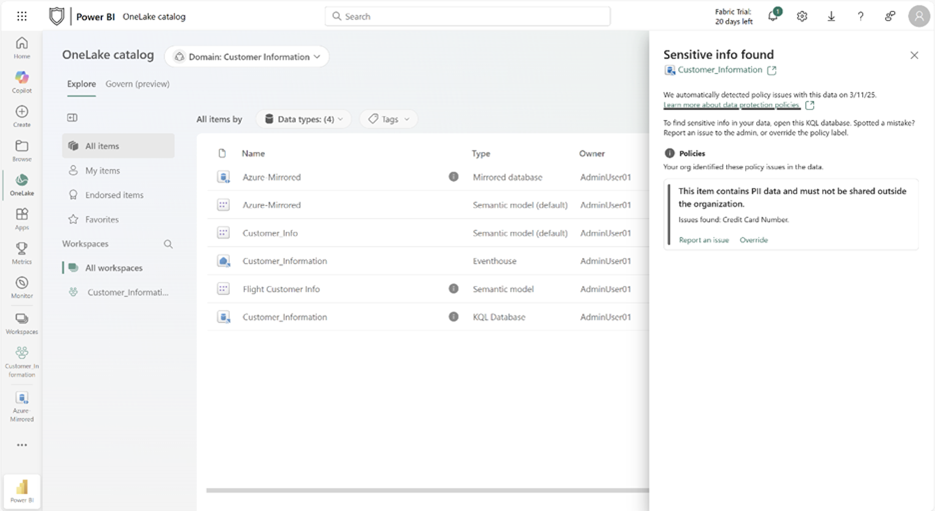
2. Microsoft Purview Information Protection
Microsoft Purview Information Protection is the native data discovery, classification, and labeling platform for Microsoft 365, Azure, and Windows endpoints. It covers Exchange Online, SharePoint, OneDrive, Teams, and Windows devices through sensitivity labels and unified policies.
Source: microsoft.com
Key features:
- Native classification and sensitivity labeling across Exchange Online, SharePoint, OneDrive, Teams, and Windows endpoints, with labels carrying through AI app interactions.
- Trainable classifiers and customizable sensitive information types (SITs) for pattern- and machine-learning-based detection.
- Auto-labeling, mandatory labeling, and end-user policy tips for consistent enforcement.
- Integration with Microsoft Defender for Cloud Apps, Defender for Endpoint, and Microsoft Sentinel for response.
- DSPM for AI capabilities, including posture reports and guided workflows for sensitive data discovery.
What to consider:
- It doesn't natively support SAP or Oracle, and on-premises NAS requires a separate scanner component.
- Custom trainable classifiers support English only and can't be retrained once published.
Best for: Organizations standardized on Microsoft 365 and Azure wanting classification embedded in their existing ecosystem.
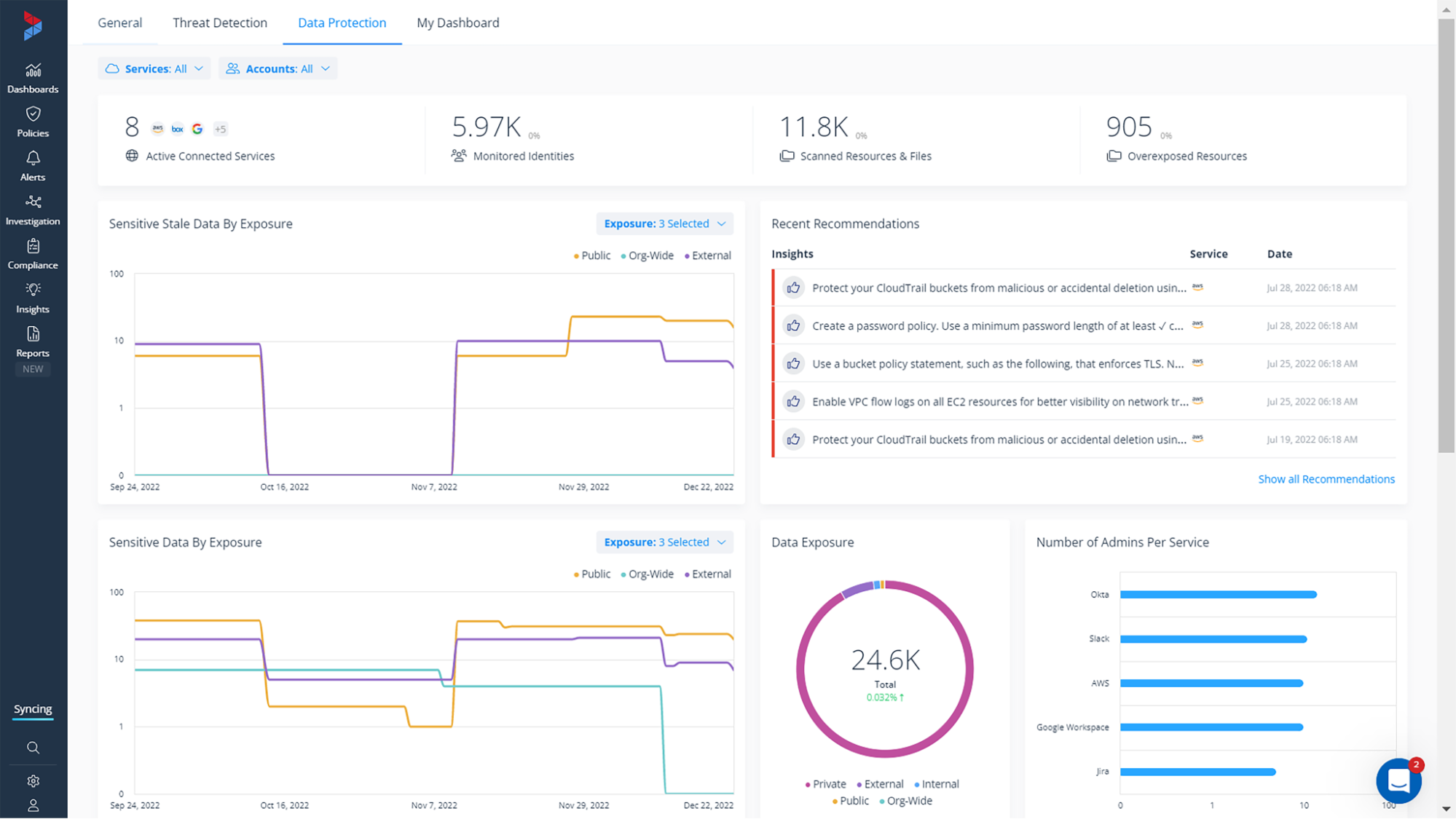
3. Varonis Data Security Platform
Varonis is a data security platform with deep classification and behavioral analytics across unstructured data in file servers, NAS, Microsoft 365, and collaboration platforms. It flags anomalous access to classified data in real time.
Source: varonis.com
Key features:
- Discovery and classification of sensitive data across on-premises file servers, SharePoint, OneDrive, and collaboration environments.
- Effective permissions analysis across direct and inherited group membership, with owner-driven entitlement reviews.
- User and entity behavior analytics (UEBA) for anomalous access and insider threat detection using machine-learning baselining.
- Automated remediation that removes global access groups, fixes broken inheritance, and right-sizes permissions.
What to consider:
- The self-hosted platform reaches end of life on December 31, 2026, forcing migration to SaaS.
- Structured database and cloud data warehouse classification are shallower than purpose-built DSPM tools.
Best for: Organizations whose primary risk is unstructured file data and collaboration platforms, where behavioral monitoring matters as much as classification.
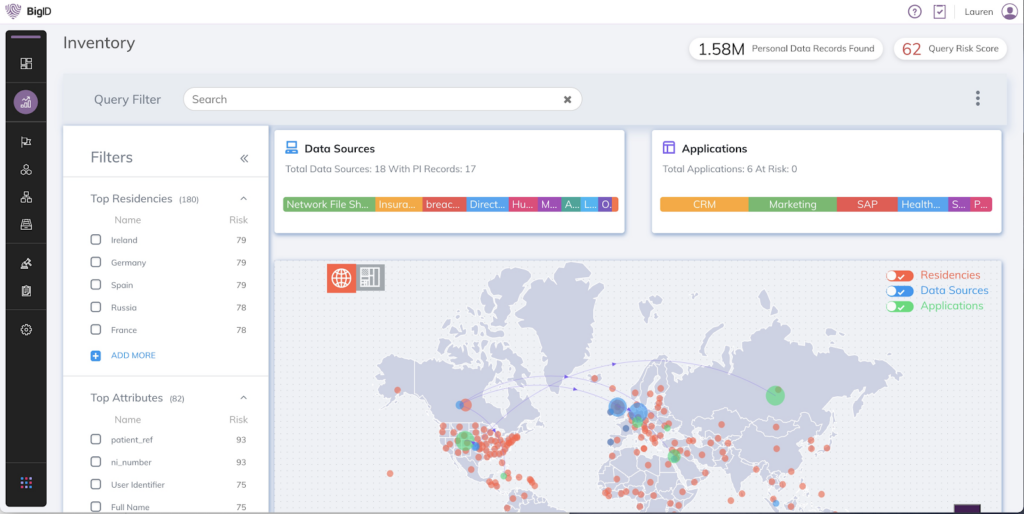
4. BigID
BigID is a data discovery and intelligence platform anchored in privacy, security, and governance use cases. It classifies personal and sensitive data at scale across structured and unstructured stores in hybrid and cloud environments, with privacy workflows tied to classification findings.
Source: bigid.com
Key features:
- Machine learning discovery and classification across databases, data lakes, object storage, SaaS, and on-premises systems, with multi-language support.
- AI classifiers, pattern recognition, natural language processing, and named entity recognition for structured and unstructured data.
- Data mapping and inventory supporting records of processing activities (RoPA), Data Protection Impact Assessments (DPIA), and consent management.
- AI governance covering shadow AI discovery, AI security posture management, and agentic data access controls.
- Integration with Microsoft Purview, Splunk, ServiceNow, and cloud-native DLP, with an extensible framework for custom data types.
What to consider:
- Broad rollouts across dozens of data stores and custom taxonomies extend time to full coverage.
- The platform emphasizes breadth of discovery over deep permissions and access governance analysis, so access depth may require a separate tool.
Best for: Enterprise privacy, compliance, and security teams managing multi-framework obligations such as GDPR, CCPA, and HIPAA, needing classification integrated into DSAR workflows.
5. Sentra
Sentra is a cloud-first data security platform that discovers and classifies sensitive data across multi-cloud environments using an agentless, in-environment scanning model. Its DataTreks capability tracks how classified data moves across cloud services.
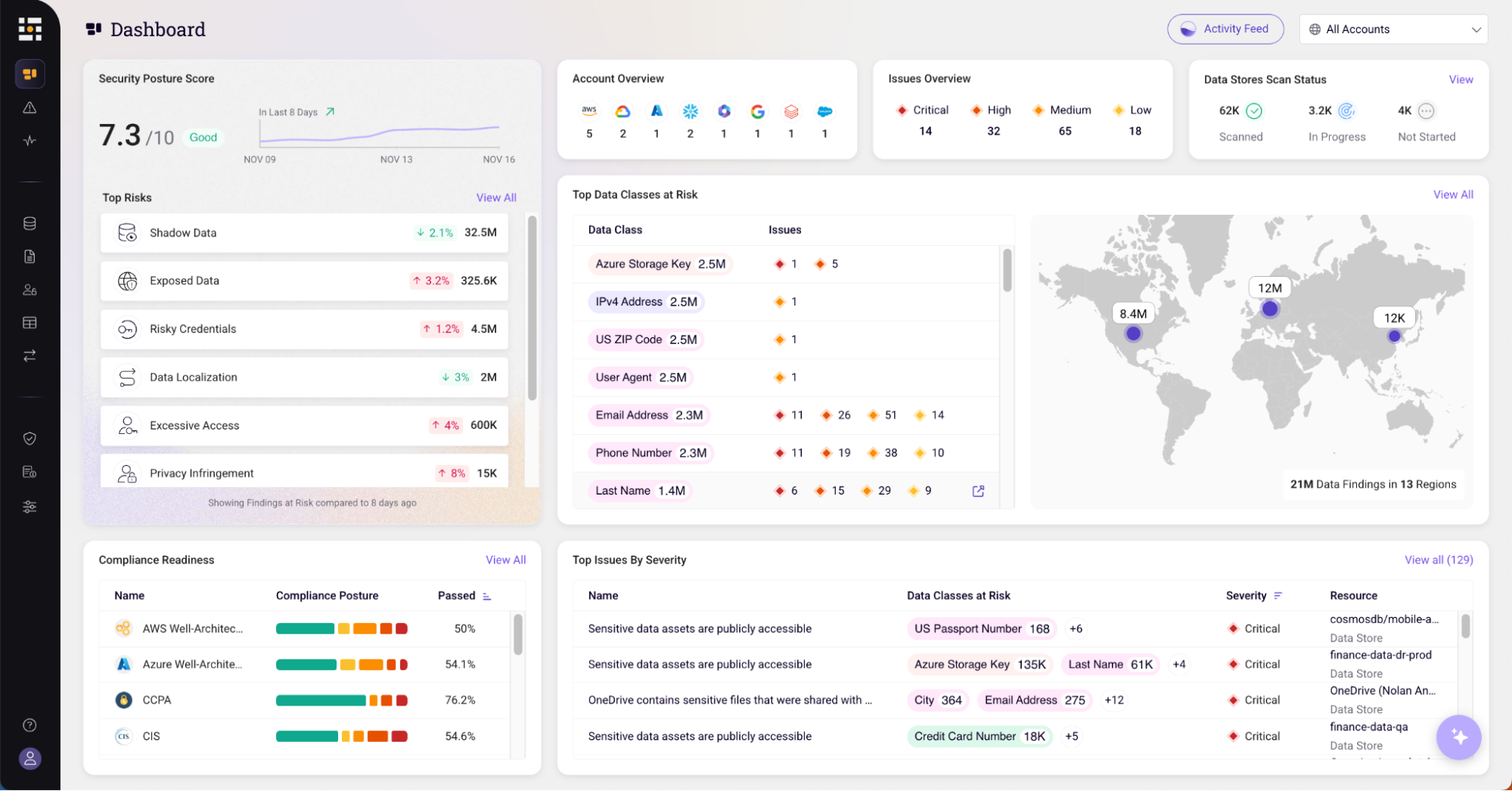
Source: https://sentra.io/
Key features:
- Agentless discovery and classification across AWS, Azure, GCP, Snowflake, Databricks, BigQuery, Amazon Redshift, and MongoDB Atlas.
- Risk prioritization based on data sensitivity, access exposure, and misconfiguration.
- In-environment scanning that keeps classified data within the customer's cloud boundary and processes only metadata externally.
- DataTreks monitors how sensitive data propagates across cloud services.
- AI governance focused on data exposure and generative AI risk.
What to consider:
- On-premises coverage is limited compared with the depth of its cloud-native offerings.
- It focuses on discovery and posture rather than enforcement, so blocking data movement needs a separate DLP layer.
Best for: Cloud-first organizations managing sensitive data across cloud stores needing agentless discovery with data movement visibility.
6. Cyberhaven
Cyberhaven is a data detection and response (DDR) platform that classifies data by lineage, tracing it from its origin through every movement across applications and endpoints. A file copied from a customer database to a personal cloud drive carries that origin in its lineage.
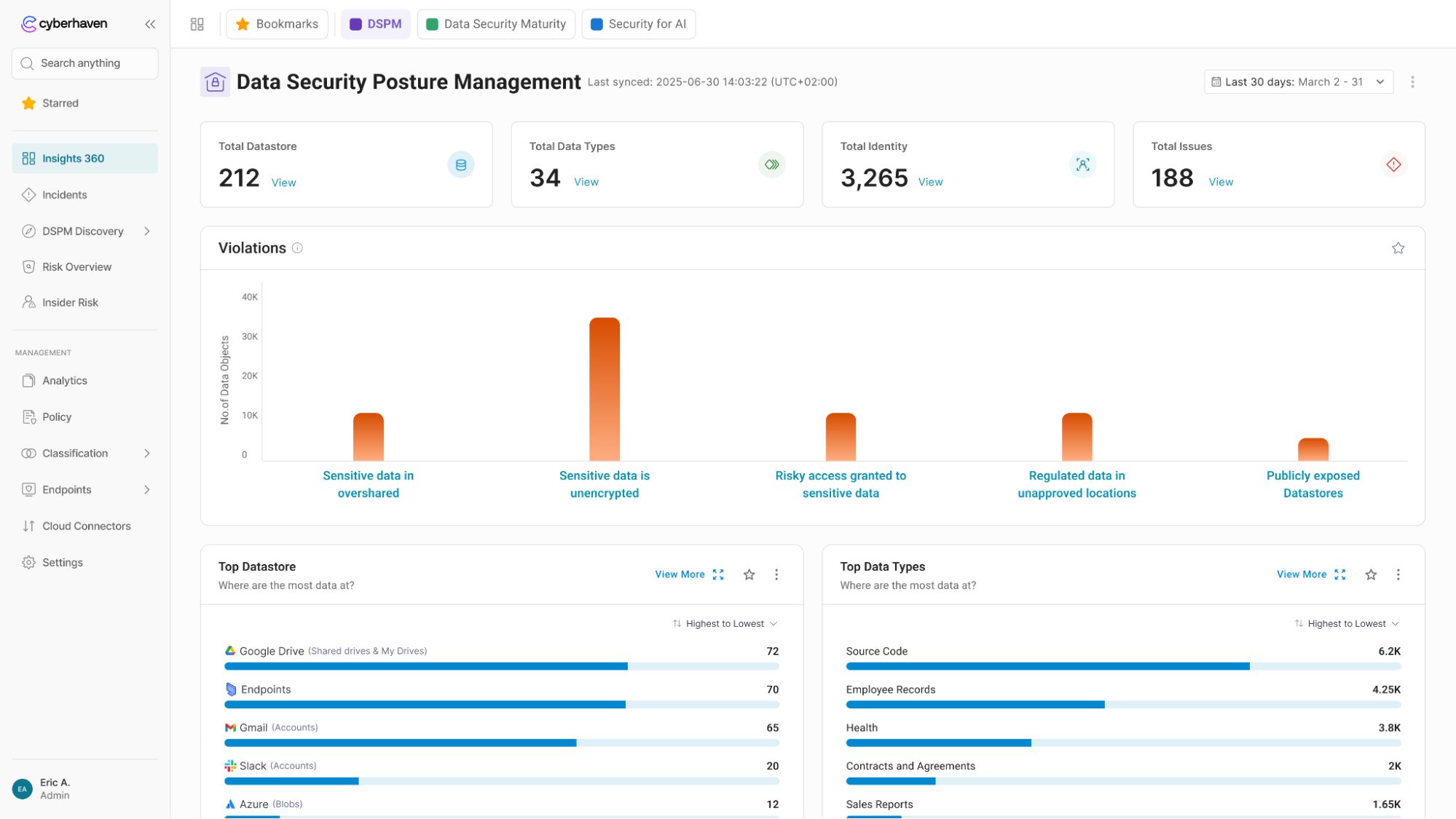
Source: cyberhaven.com
Key features:
- Data lineage tracking that traces how sensitive data moves between applications, users, and repositories.
- Classification combining content inspection, behavioral context, and lineage for precise policy targeting.
- Real-time response to risky movement such as personal cloud uploads, screenshots, clipboard operations, and printing.
- Coverage across endpoints, cloud storage, and SaaS applications.
- Linea AI analyst agent for autonomous investigation.
What to consider:
- It requires endpoint agents and application-level integration, so it can't scan static repositories at rest.
- It targets data in motion, so compliance programs still need a repository-scanning classifier for data at rest.
Best for: Organizations prioritizing intellectual property protection and insider risk, where how classified data moves matters more than where it rests.
7. Securiti
Securiti is a unified data security and privacy platform that links discovery and classification to privacy, security posture, and governance workflows through its Data+AI Command Center architecture. Veeam acquired Securiti in December 2025.
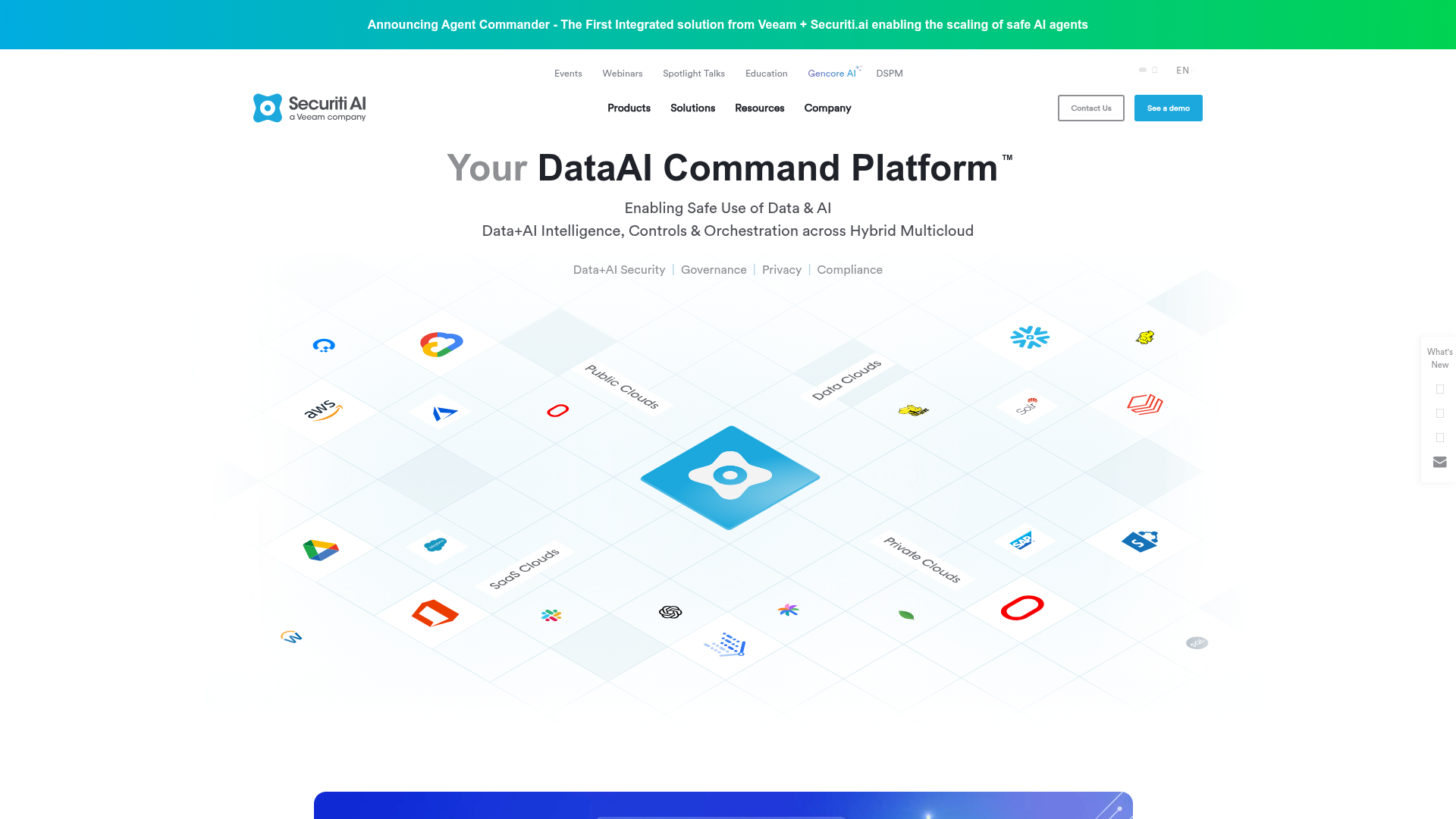
Source: securiti.com
Key features:
- 400-plus classifiers across cloud services, SaaS, and on-premises systems, powered by the Data Command Graph knowledge graph.
- Integrated privacy workflows for DSAR fulfillment, consent management, and records of processing.
- Data security posture views highlighting exposed sensitive data and access misconfigurations.
- Automated remediation and a no-code policy builder for enforcement.
- AI security controls for AI pipeline protection and context-aware action governance.
What to consider:
- The December 2025 Veeam acquisition leaves the long-term roadmap and integration direction subject to change.
- Discovery-and-classification-only buyers won't use much of the broader privacy and governance platform.
Best for: Organizations needing discovery and classification for both privacy operations and security posture management on a single platform.
8. Spirion Sensitive Data Platform
Spirion is a sensitive data discovery and classification platform with endpoint-first depth, protecting data on laptops, desktops, servers, and removable media. archTIS acquired Spirion in October 2025.
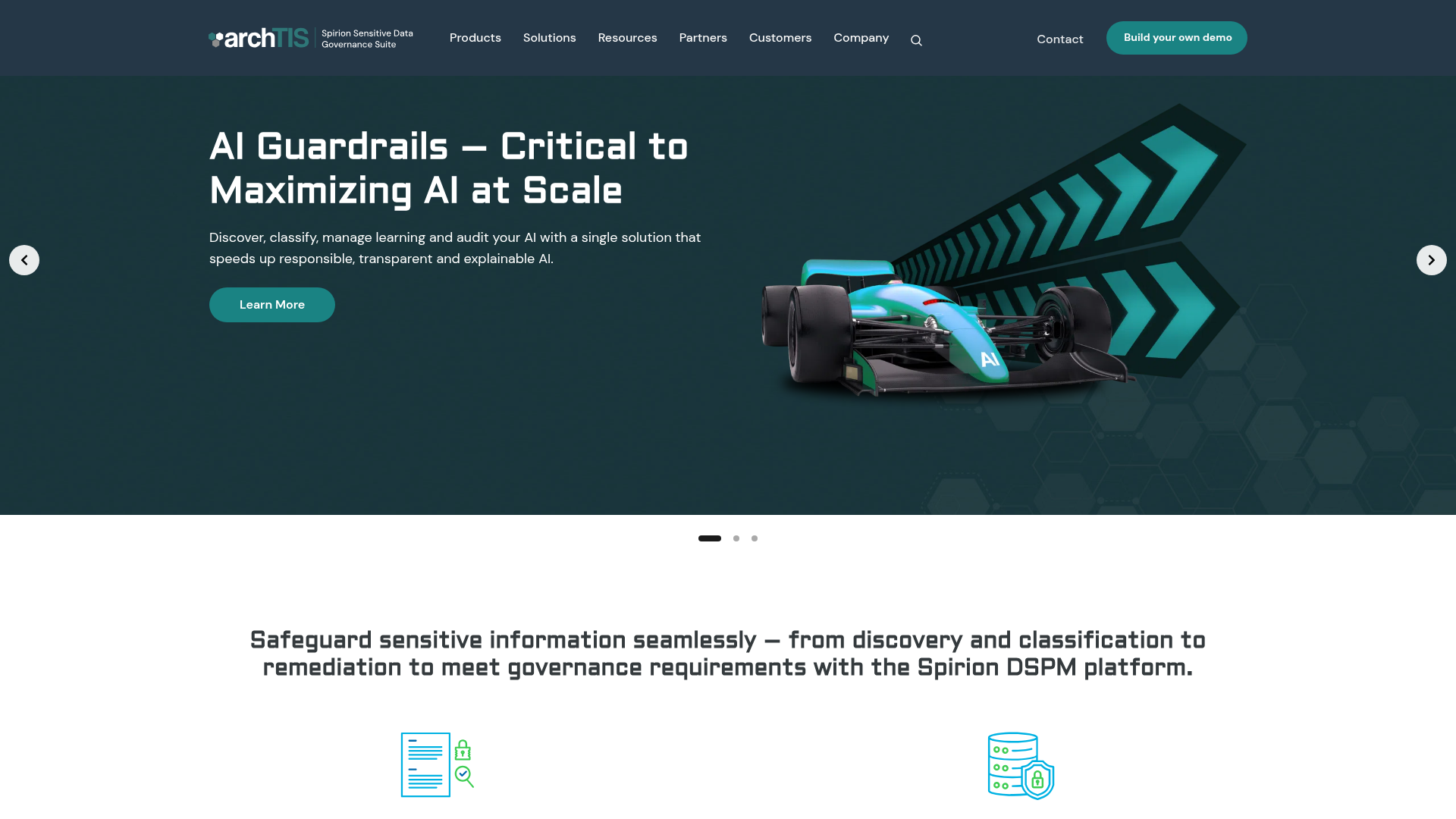
Source: spirion.com
Key features:
- Endpoint discovery scanning Windows, macOS, and Linux workstations, laptops, and servers for data at rest.
- AnyFind pattern matching, checksum validation, and proximity analysis for detection.
- CADIA (Context-Aware Data Intelligence Architecture) for human-in-the-loop false-positive reduction.
- Remediation actions triggered directly by classification findings.
- Prebuilt support for regulated data discovery across GDPR, HIPAA, and PCI DSS use cases.
What to consider:
- Cloud-first SaaS and data warehouse coverage is narrower than that of purpose-built DSPM tools.
- It surfaces and remediates sensitive data but doesn't map who can access it, so permissions analysis needs a separate tool.
Best for: Organizations whose highest-risk exposure is to endpoints and file systems, particularly in regulated healthcare and financial services environments.
How to choose the right data discovery and classification tool in 2026
A vendor demo runs against a clean, curated sample dataset every time. Your actual file servers, NAS shares, and legacy databases look messier, and that gap is exactly where accuracy claims tend to fall apart.
Five checks catch it early:
- Inventory your repositories before touching a demo: On-premises file servers, NAS, and legacy databases need full hybrid coverage that a cloud-only scanner can't provide; cloud-first estates can lead with an agentless option instead.
- Match the tool to the job it has to do: DSAR and privacy workflows, insider risk and data lineage tracking, and endpoint-resident discovery are different problems that pull toward different vendors on this list.
- Validate classification accuracy on your own data: Run a proof of concept against your actual files and databases before expanding scope, since demo-dataset accuracy claims don't always hold up on yours.
- Confirm classification ties to identity and permissions context: An isolated list of sensitive files can't be acted on; the finding needs to connect to who can actually reach that data.
- Weigh the budget case on remediation over inventory size: Tools that connect classification to identity context and automated remediation translate into a measurable reduction in standing exposure. That's the stronger case to leadership than a more complete inventory alone.
For hybrid Microsoft environments, Netwrix Data Classification handles the discovery, tagging, and remediation this guide covers.
Pair it with Netwrix Access Analyzer to map findings to the identities that can reach them, and Netwrix DSPM to extend coverage to cloud-native stores across AWS, Azure, and GCP.
Request a demo to see how Netwrix maps sensitive data to the identities that can reach it across your environment.
Disclaimer: The information in this article is current as of August 2026. Verify current capabilities directly with each provider.
Frequently asked questions about data discovery and classification tools
Share on
Learn More
About the author

Netwrix Team
Learn more on this subject
Insider risk starts with who can read the data
NIST CSF 2.0: What's new in the Cybersecurity Framework
From noise to action: turning data risk into measurable outcomes
Data Privacy Laws by State: Different Approaches to Privacy Protection
What Is Electronic Records Management?