
9 best DLP solutions for enterprise data protection in 2026
Mar 10, 2026
Enterprise DLP in 2026 must cover far more than just email and USB channels. Sensitive data now flows through cloud collaboration platforms, SaaS applications, and GenAI prompts, channels most legacy DLP tools can't inspect. Choosing the right platform means mapping where sensitive data lives, identifying real exfiltration paths, and confirming the tool distinguishes human from non-human identity behavior.
Enterprise adoption of Microsoft Copilot and browser-based AI tools has introduced data flows that most data loss prevention (DLP) solutions can't monitor. Sensitive data now moves through cloud collaboration platforms, SaaS applications, and GenAI prompts, channels where legacy DLP provides little or no visibility.
When legal or compliance asks which sensitive data Copilot can access, many traditional DLP tools can't answer.
That gap is driving a broader reevaluation of how enterprises approach data loss prevention. The question is no longer whether to replace or augment legacy DLP, but which architecture best fits how data actually moves today. The gap itself is widening, as many organizations are building their own AI tools, predominantly in Linux environments, which are quite often a blind spot for DLP solutions.
Nine enterprise-grade platforms follow, spanning endpoint, network, cloud/SaaS, email, storage, and browser/GenAI channels, with a framework to help you choose the right one for your environment. Pair this comparison with a DLP policy structured around your highest-risk data rather than deploying broad, untuned rules on day one.
The 9 best DLP solutions at a glance
GenAI and browser-based data flows didn't exist when most of these platforms were originally built, so this list spans everything from decades-old network appliances to purpose-built AI-era tools.
The table captures deployment model and primary focus at a glance; the profiles below go further into what each one can and can't see.
Vendor | Primary focus | Deployment | Best for |
|---|---|---|---|
|
Identity-aware, converged DSPM and DLP |
SaaS, on-premises, hybrid |
Hybrid enterprises (Microsoft and Linux) wanting DLP, DSPM, and identity security together |
|
|
Microsoft Purview DLP |
Native Microsoft 365 DLP |
Cloud (Microsoft 365, Azure) |
Microsoft-heavy organizations with most sensitive data inside M365/Azure |
|
Symantec DLP (Broadcom) |
Full-stack enterprise DLP |
On-premises, hybrid, cloud |
Global enterprises in regulated industries needing maximum channel coverage |
|
Forcepoint DLP |
Behavioral, risk-adaptive DLP |
On-premises, hybrid, cloud |
Regulated enterprises with complex insider threat concerns |
|
Proofpoint Enterprise DLP |
People-centric, email-first DLP |
Cloud, hybrid |
Enterprises where email is the primary exfiltration concern |
|
Trellix DLP |
Multi-channel legacy DLP |
On-premises, hybrid, cloud |
Organizations consolidating on the Trellix portfolio |
|
Digital Guardian (Fortra) |
Kernel-level endpoint DLP |
SaaS, on-premises, managed, hybrid |
Enterprises where endpoint IP protection is the primary concern |
|
Trend Micro (integrated DLP) |
DLP embedded in Vision One XDR |
Cloud, hybrid |
Organizations already consolidating on Trend Micro for endpoint and email |
|
Cyberhaven |
Data lineage and detection/response |
Cloud, SaaS, endpoint |
Cloud-native or IP-heavy teams with significant GenAI usage |
Deployment model and primary focus narrow the shortlist, but neither shows whether a tool can actually tell a human employee apart from a service account moving the same file, which is the gap most of this list still hasn't closed. The channel breakdown that follows is a sharper way to evaluate fit
Types of DLP solutions
DLP tools are typically built around a single primary channel, even when they extend to others. Knowing which type you're evaluating clarifies what it will and won't catch.
- Endpoint DLP: Monitors activity on laptops and workstations, including USB transfers, clipboard actions, and local file operations. Digital Guardian and Netwrix Endpoint Protector lead with this approach.
- Network DLP: Inspects data in transit across the corporate network, typically through deep packet inspection. Symantec DLP and Trellix DLP both cover this channel.
- Cloud/SaaS DLP: Extends coverage to SaaS applications and cloud storage, where email- and network-only tools have no visibility. Microsoft Purview DLP and Netwrix 1Secure are built around this channel for Microsoft-centric estates.
- Email DLP: Focuses on outbound and inbound message content, attachments, and sender behavior. Proofpoint Enterprise DLP leads with this approach.
- Browser and GenAI DLP: Inspects browser sessions and AI prompt submissions, the channel legacy DLP was never designed to see. Symantec's 25.1 release and Netwrix's browser-based DLP both directly target this gap.
- Data detection and response (DDR): A newer category that traces data lineage across its full movement history rather than enforcing policy only at fixed inspection points. Cyberhaven represents this approach.
Most enterprise environments need coverage across several of these types simultaneously, since sensitive data moves through multiple channels within the same workday.
Netwrix Endpoint Protector blocks sensitive data uploads to AI tools across endpoints and browser sessions. Get a demo
What to look for in a DLP solution
Channel coverage from the list above sets the floor for evaluation. Six criteria, on top of that, separate tools that reduce real risk from those that just produce a longer alert queue.
- Detection accuracy over raw rule count: A large library of regex patterns and classifiers matters less than how few false positives it generates in your own environment. Test this with a proof of concept on real data before committing.
- Channel breadth matched to your actual data flows: Map where sensitive data moves today, including browser-based AI tools and cloud collaboration platforms, then confirm the tool covers those specific channels rather than a generic set.
- Identity- and non-human-identity-aware detection: Confirm whether the tool distinguishes a human employee, a service account, and an AI agent moving the same file. The Netwrix 2026 Data and Identity Security Report found that 76% of organizations don't fully govern or monitor non-human identities with data access. A policy that treats all three identity types the same misses that exposure entirely.
- Identity-attributed audit trail for incident response: A blocked-event log tells you a policy fired. It doesn't tell you who the identity was, what they accessed before the block, or whether the same identity touched other sensitive data first. Confirm the tool produces evidence usable in an actual investigation, beyond a raw alert.
- Integration with DSPM and identity security: Enterprises increasingly need converged data security posture management (DSPM), DLP, and identity threat detection and response (ITDR) capabilities, with policies driven by data sensitivity and identity context. Building a data-driven, exposure-aware security strategy covers that architecture in more depth.
- Regulatory and compliance mapping: GDPR, HIPAA, PCI DSS, and sector-specific frameworks require a complete account of how data moved and who had access, beyond a simple log export. Confirm the tool maps evidence to your specific compliance obligations, rather than generic templates.
The following comparison evaluates nine solutions across these categories to help you identify which approach best fits your environment, data flows, and operational capacity.
1. Netwrix 1Secure (with DLP and Netwrix Endpoint Protector)
The DLP question increasingly centers on who has access to what sensitive data and how it moves; preventing data from leaving requires more than a standalone DLP tool.
Netwrix 1Secure brings together DSPM, ITDR, and endpoint DLP through a fully integrated Netwrix Endpoint Protector, providing identity-aware data protection for Microsoft-heavy and hybrid enterprises.
Rather than treating DLP as an isolated silo, Netwrix 1Secure delivers protection through browser-based DLP for GenAI tools, Microsoft 365 DSPM with built-in detection patterns, identity threat detection, and cross-platform endpoint controls.
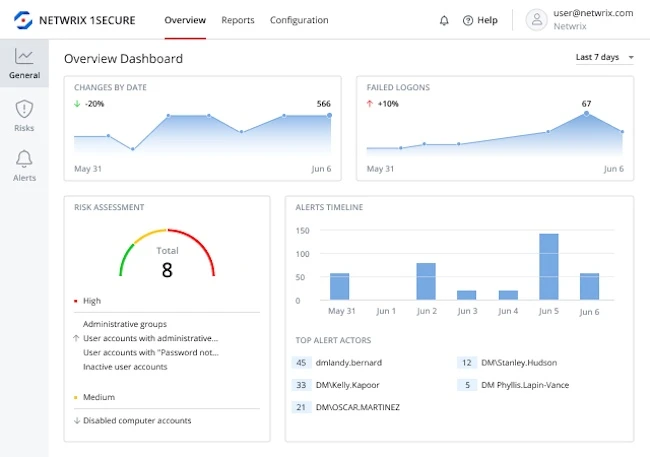
Key features:
- Browser-based DLP monitors data shared through GenAI tools, including Microsoft Copilot, across major browsers (Chrome, Edge, Firefox, Safari, and Opera).
- Netwrix Endpoint Protector provides USB device control with enforced encryption, clipboard monitoring, and content-aware policies across Windows, macOS, and Linux.
- Microsoft 365 DSPM discovers and classifies sensitive data across SharePoint Online, OneDrive, Teams, and Copilot.
- Identity-aware protection through Active Directory and Microsoft Entra ID integration detects stale accounts, unnecessary privileges, and misconfigurations, and ties blocked events to the identities behind them.
What to consider:
- Coverage is deep in Microsoft-centric hybrid estates and Linux environments, so teams that are heavily AWS-native or GCP-first should validate connector depth during evaluation.
- Portfolio breadth means some mid-market teams start with a subset of modules and expand as the DLP and DSPM program matures.
Best for: Mid-market and enterprise organizations with Microsoft-centric hybrid environments that want to combine DLP with DSPM and identity security while addressing GenAI and browser risks without deploying separate point products.
2. Microsoft Purview DLP
Microsoft Purview DLP provides native data loss prevention within the Microsoft Purview suite, covering M365 workloads and Windows endpoints. Security teams should note that the solution has real gaps outside Microsoft environments, including a lack of native support for non-Microsoft cloud services, Linux endpoints, or mobile devices.
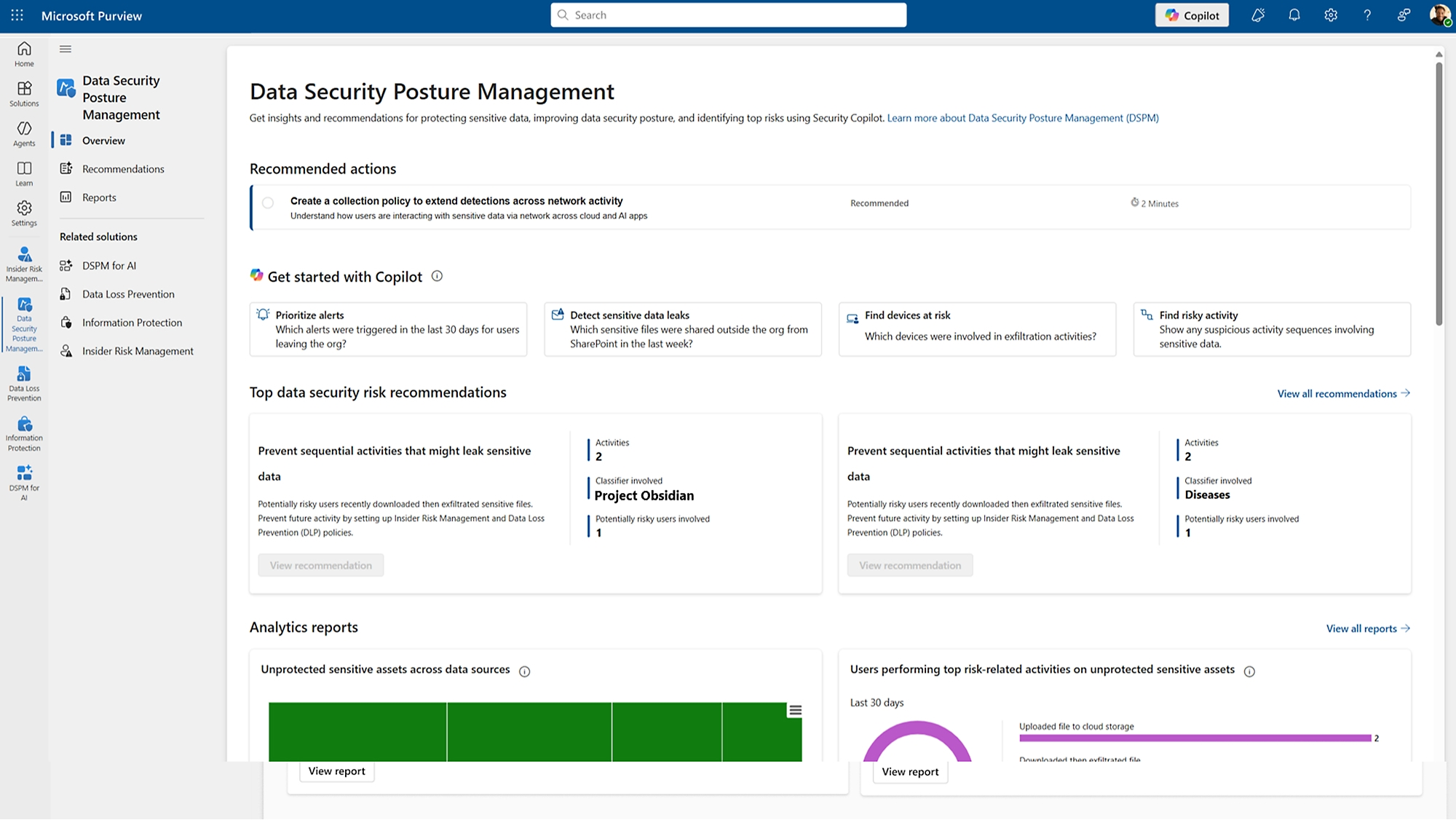
Source: microsoft.com
Key features:
- Unified sensitivity labels and DLP policies across Exchange, SharePoint, OneDrive, and Teams (Teams DLP requires E5 licensing).
- Endpoint DLP for Windows 10/11 and macOS (latest three versions); not supported on Linux or mobile devices.
- Pre-built regulatory templates for PCI DSS, HIPAA, GDPR, CCPA, and GLBA.
- Adaptive Protection using machine learning and insider risk signals.
What to consider:
- Limited native support for non-Microsoft cloud services (AWS, GCP, Salesforce).
- Teams chat DLP requires E5/A5/G5 licensing, creating significant cost considerations.
- Policy configuration consistently has a steep learning curve.
Best for: Microsoft-heavy organizations where 80%+ of sensitive data resides within M365/Azure, and that are willing to complement it with other tools for non-Microsoft channels.
3. Symantec DLP (Broadcom)
Symantec DLP remains an actively developed, full-stack enterprise DLP solution under Broadcom ownership. The Enforce Platform provides centralized policy management across network, endpoint, storage, email, and cloud channels.
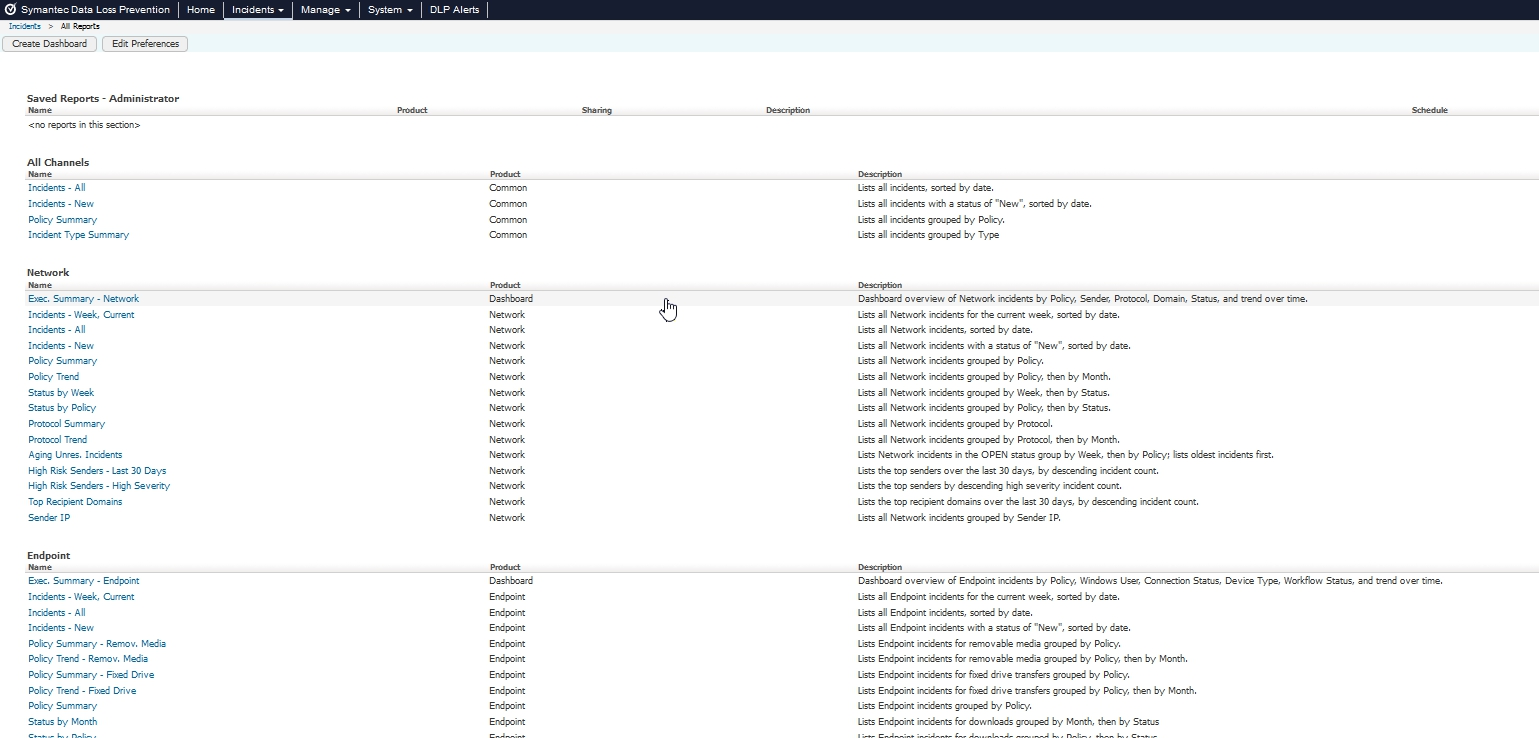
Source: knowledge.broadcom.com
Key features:
- Network DLP with deep packet inspection for data-in-motion protection.
- Native browser API integration (Chrome, Edge for Business, Firefox) with GenAI clipboard inspection for AI tool interactions.
- Exact Data Matching (EDM), OCR, and pattern matching for content inspection.
- User and Entity Behavior Analytics through Information Centric Analytics.
- Microsoft Purview Information Protection integration (v16.1) for unified sensitivity labeling.
What to consider:
- Complex implementation requiring significant planning and dedicated DLP expertise.
- Ongoing policy tuning is challenging and demands dedicated staff.
- Steep learning curve for administrators in multi-channel deployments.
Best for: Global enterprises in regulated industries needing maximum channel coverage with dedicated security teams.
4. Forcepoint DLP
Forcepoint DLP distinguishes itself through Risk-Adaptive Protection (RAP), a behavioral analytics engine that tracks over 130 Indicators of Behavior per user to calculate real-time risk scores and enable graduated responses.
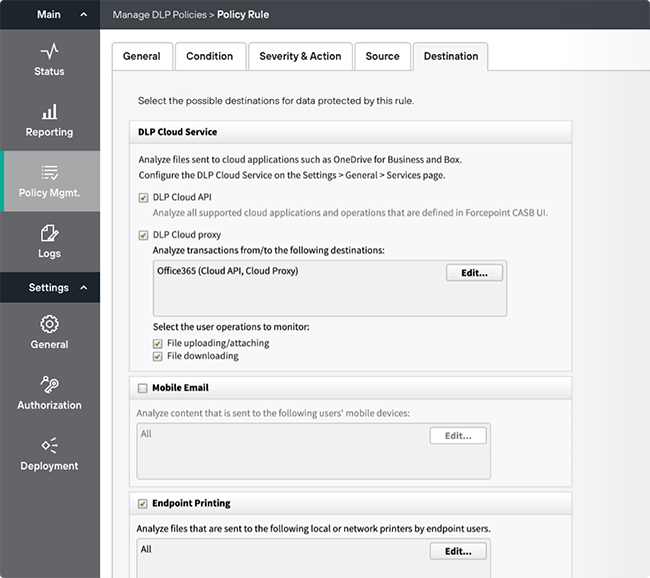
Source: help.forcepoint.com
Key features:
- Endpoint protection for Windows and Mac with on-network and off-network coverage.
- Risk-Adaptive Protection with real-time behavioral baselining and dynamic policy adjustment.
- AI Mesh technology for protecting data in generative AI and LLM interactions.
- Drip DLP detection for identifying slow-leak data exfiltration.
What to consider:
- Agent deployment is resource-intensive for large device fleets.
- Implementation requires careful planning with higher total cost of ownership reported.
- Best suited for organizations with dedicated security teams.
Best for: Regulated enterprises with complex insider threat concerns and operational capacity for behavior-driven policy management.
5. Proofpoint Enterprise DLP
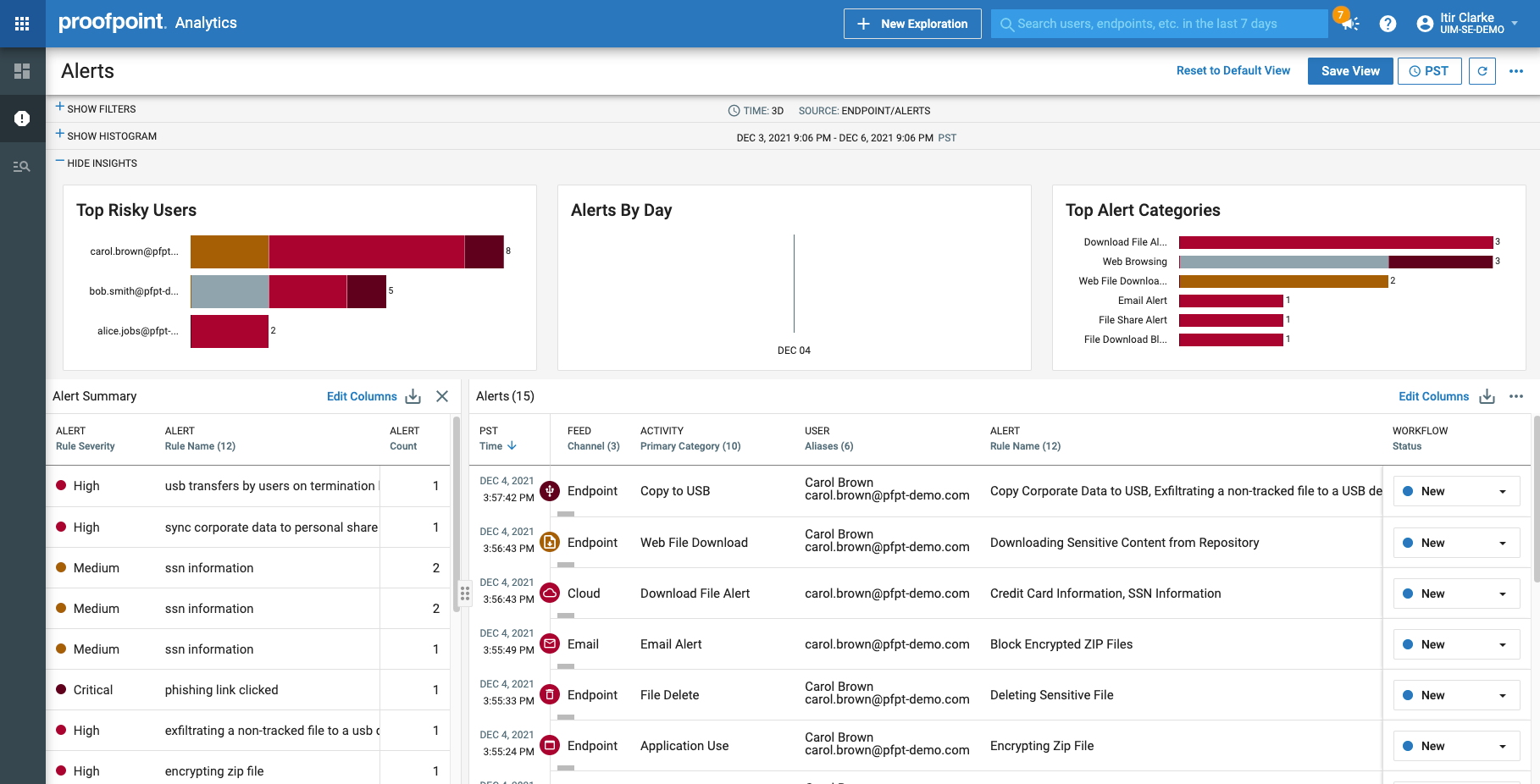
Proofpoint Enterprise DLP leads with a people-centric security model that combines content inspection, user behavior analytics, and threat intelligence to distinguish among negligent, malicious, and compromised insiders. Proofpoint acquired Acuvity in February 2026, adding AI-native visibility and governance for agentic and AI-driven workflows to the platform.
Source: g2.com
Key features:
- Adaptive Email DLP using behavioral AI to analyze employee email patterns and trusted relationships.
- AI agent and agentic workflow visibility through the Acuvity acquisition, extending insider risk detection to AI-driven data access.
- Integrated insider threat management combining DLP detection with user risk profiling.
- Human Risk Explorer provides a centralized dashboard that correlates DLP incidents with risky user activities.
- Unified omni-channel policies spanning email, Microsoft 365, Google Workspace, and endpoints.
What to consider:
- Broader multi-cloud SaaS coverage beyond Microsoft 365 and Google Workspace is still evolving.
- Initial configuration and policy tuning require dedicated security expertise.
- AI agent governance from the Acuvity acquisition is newly integrated, so buyers should confirm current depth against their specific agentic AI use cases.
Best for: Enterprises where email is the primary exfiltration concern and insider threat detection, including AI agent activity, is a strategic priority.
6. Trellix DLP
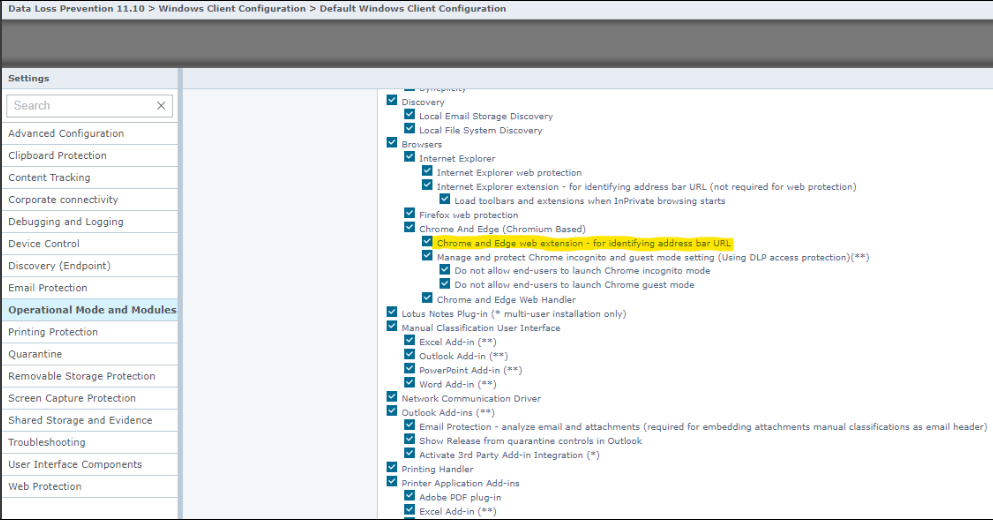
Trellix DLP (formerly McAfee Enterprise DLP) provides mature, multi-channel data protection with centralized policy management across endpoint, email, web, network, and cloud.
Source: support.trellix.com
Key features:
- Endpoint DLP for Windows and macOS with device control and application-level monitoring.
- Network Monitor and Network Prevent for traffic scanning and active blocking.
- Browser support across Chrome, Edge, Firefox, and Safari.
- Integration with Trellix EDR and XDR platforms.
What to consider:
- Enterprise users consistently report significant operational complexity.
- High false positive rates leading to alert fatigue.
- Endpoint performance impacts related to resource consumption.
Best for: Organizations already on the Trellix portfolio seeking vendor consolidation, willing to invest in policy tuning.
7. Digital Guardian (Fortra)
Digital Guardian deploys kernel-level agents on Windows, macOS, and Linux that monitor system events and data interactions at the operating system core. Through Exact Data Matching (EDM) and Database Record Matching (DBRM), it identifies sensitive intellectual property across multiple data formats.
Source: fortra.com
Key features:
- Kernel-level endpoint agents providing real-time event capture for file operations, network communications, and removable media.
- EDM fingerprinting structured data and DBRM for engineering specs, financial models, and source code.
- OCR scanning of images and screenshots for embedded sensitive text.
- Flexible deployment: SaaS, on-premises, managed services, or hybrid.
What to consider:
- Resource-intensive agents can cause performance issues, particularly on older hardware.
- Complex deployment and management requiring dedicated staff or professional services.
- Higher total cost of ownership when accounting for operational overhead.
Best for: Enterprises in regulated industries where endpoint data movement and intellectual property protection are the primary concern.
8. Trend Micro (integrated DLP)
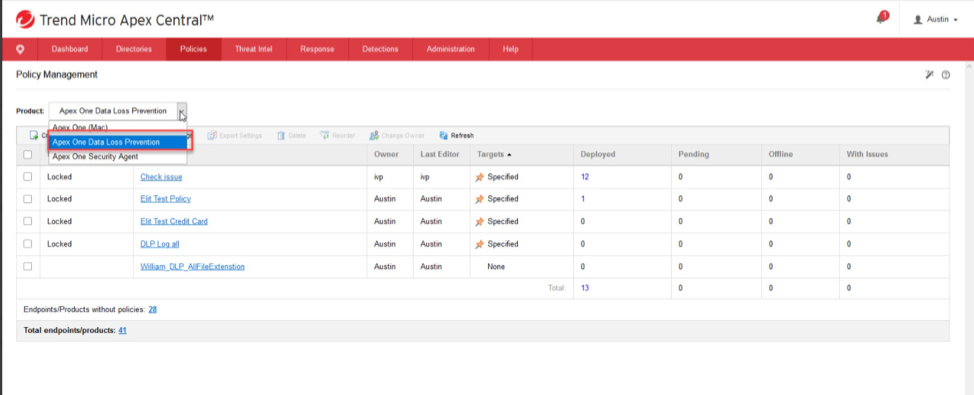
Trend Micro DLP capabilities are embedded across the Vision One platform rather than offered as a standalone product. Data protection is integrated into endpoint, email, web, and cloud application security layers and managed through a single console.
Source: success.trendmicro.com
Key features:
- Device control for USB devices and external storage at the endpoint layer.
- Content-aware policies using keywords, regular expressions, and data identification patterns.
- Predefined compliance templates for GDPR, HIPAA, and PCI-DSS with automated incident workflows.
- Native integration with Vision One XDR for correlated threat and data protection.
What to consider:
- Lacks at-rest data discovery and classification depth compared to DSPM-integrated platforms.
- A less mature policy engine than dedicated DLP platforms.
- Narrower protocol coverage and less mature behavioral analytics than purpose-built solutions.
Best for: Mid-size organizations already consolidating on Trend Micro for endpoint and email security that need baseline DLP for compliance.
9. Cyberhaven
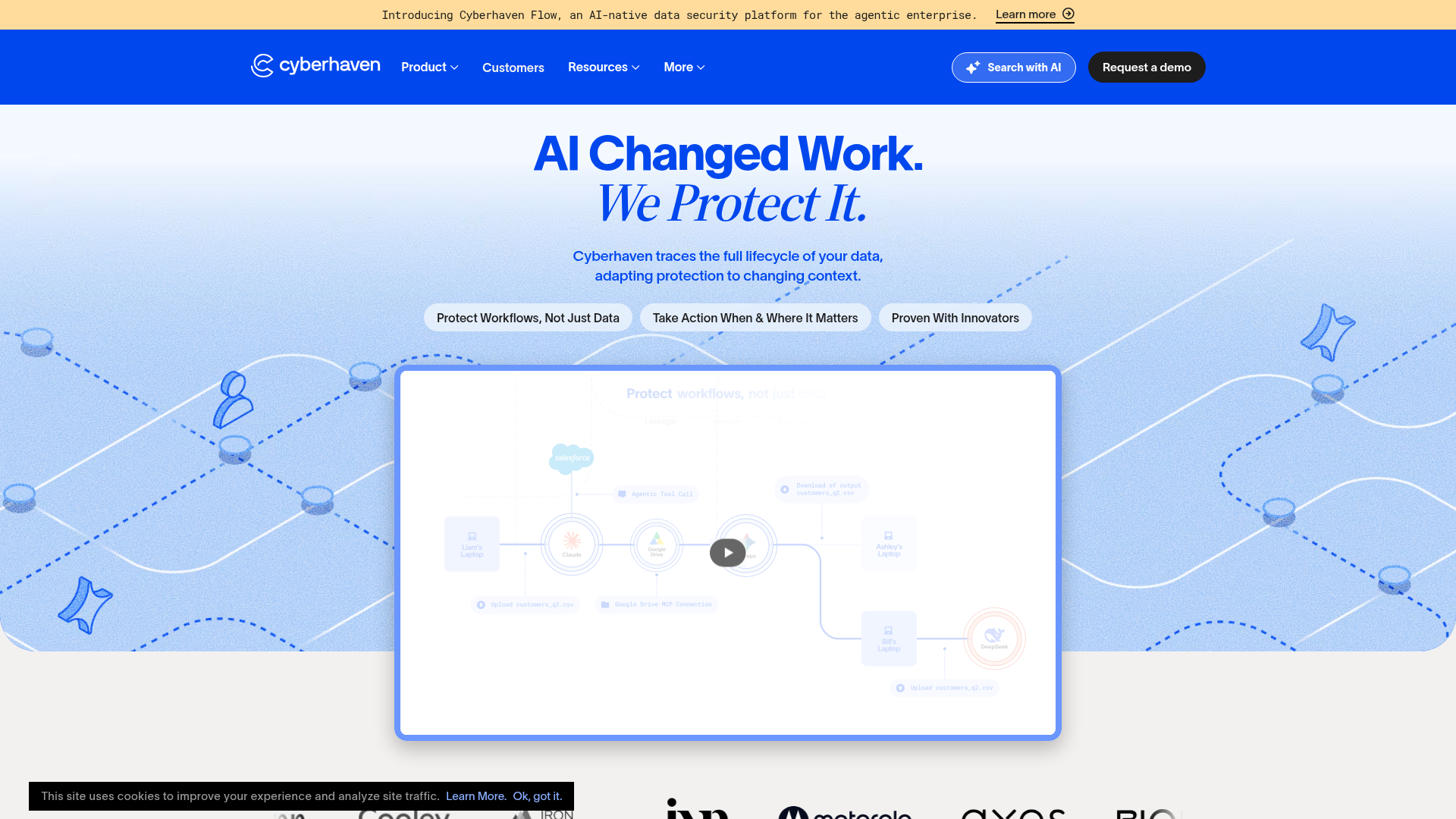
Cyberhaven builds from the ground up around data lineage tracking. Instead of inspecting content at enforcement points, the platform traces how sensitive data moves between applications, users, and repositories, tracking origin, modifications, and movement at the snippet level.
Source: cyberhaven.com
Key features:
- Dynamic Data Tracing provides rich data lifecycle tracking across endpoints, SaaS, and cloud.
- Native API connectors for Microsoft 365, Google Workspace, Slack, and developer tools, including GitHub.
- GenAI controls monitoring data flowing into ChatGPT, Claude, Gemini, and Perplexity.
- Large Lineage Model (LLiM) providing natural language explanations and automated risk prioritization.
What to consider:
- No identity security or ITDR integration, meaning data protection policies operate without visibility into who holds compromised credentials or escalated privileges.
- Cloud-native architecture with no on-premises coverage for organizations running hybrid or legacy infrastructure.
- No endpoint device control, USB monitoring, or enforced encryption for removable media.
Best for: Cloud-native or IP-heavy teams that need context-aware data protection across SaaS and developer workflows with significant GenAI usage.
How to choose the right DLP solution in 2026
The DLP market is moving away from single-channel enforcement toward architectures that tie data protection to identity context and data posture.
That shift changes the evaluation: the priority question becomes which tool understands who (or what identity) is moving sensitive data and whether that behavior is normal, ahead of which tool simply blocks the most channels.
Work through these steps before committing to an architecture:
- Map your actual data flows: List every channel sensitive data moves through today, including browser-based AI tools and personal cloud accounts, beyond the channels your current DLP already monitors.
- Identify your highest-risk exfiltration paths: Rank channels by both the volume of sensitive data and the ease of exfiltration, rather than defaulting to email, which legacy DLP already covers.
- Decide between standalone and converged: For security teams already managing sprawling tool stacks across endpoints, cloud, and identity, a standalone DLP product can create more operational overhead than the protection it delivers.
- Test identity and non-human identity awareness in a proof of concept: Confirm the tool distinguishes a human user from a service account or AI agent moving the same file, rather than simply blocking the transfer.
- Scope the rollout before committing: Implementing a data security platform step by step helps you realistically size the effort against your team's operational capacity.
For teams running Microsoft-heavy hybrid environments that need DLP, DSPM, and identity security on a single platform, Netwrix 1Secure combines browser-based DLP for GenAI tools, endpoint controls via Netwrix Endpoint Protector across Windows, macOS, and Linux, and identity-aware policies integrated with Active Directory and Microsoft Entra ID.
Netwrix 1Secure combines browser-based DLP for GenAI tools, endpoint controls via Netwrix Endpoint Protector across Windows, macOS, and Linux, and identity-aware policies integrated with Active Directory and Microsoft Entra ID.
This fits teams running Microsoft-heavy hybrid environments that need DLP, DSPM, and identity security on a single platform. Netwrix 1Secure closes the gaps left by standalone DLP and native Microsoft tools, without requiring a dedicated DLP team to operate.
Request a demo to see how Netwrix can help you find overexposed sensitive data, monitor GenAI and browser-based data flows, and tie every blocked event to the identity behind it.
Disclaimer: Competitor products and capabilities change frequently. Information accurate as of August 2026; verify details with each vendor for the latest updates.
Frequently asked questions about DLP solutions
Share on
Learn More
About the author

Netwrix Team
Learn more on this subject
Data classification and DLP: Prevent data loss, prove compliance
CMMC compliance and the critical role of MDM-style USB control in protecting CUI
External Sharing in SharePoint: Tips for Wise Implementation
The Importance of Data Classification for Data Loss Prevention
10 Best Practices Essential for Your Data Loss Prevention (DLP) Policy