
12 critical shadow AI security risks your organization needs to monitor
Feb 13, 2026
Shadow AI introduces security and compliance risk when employees use unapproved AI tools that move sensitive data outside organizational control. Because AI adoption outpaces governance, organizations face exposure across data leakage, audit gaps, agentic behavior, and model-level attacks. Effective shadow AI governance requires visibility into data and identity, risk-based classification, and controls that enable secure AI use without slowing teams.
Employees adopt AI tools faster than security teams can vet them, and much of that adoption happens outside approved channels. The result is shadow AI: sanctioned work moving through unsanctioned models, with sensitive data landing on servers the organization does not control.
The scale of the mismatch is measurable. The Netwrix 2026 Data and Identity Security Report found that organizations in which AI significantly expanded the number of identities accessing data reported a 43% breach rate over the prior year, compared with 11% for organizations where AI had not changed access patterns. That four-times gap is where shadow AI thrives.
AI at work drives real productivity gains. The risk comes from using it outside governed channels. When employees adopt tools without oversight, the exposure compounds: data leaks through unvetted models, compliance gaps that surface during audits, and pathways that security teams cannot monitor.
This guide explains what shadow AI security risks are, details the 12 risks worth monitoring, and lays out how to assess and prioritize them.
What are shadow AI security risks?
Shadow AI is a subset of shadow IT that refers specifically to the use of AI tools or platforms without IT department approval or oversight. A shadow AI security risk happens whenever company data moves through AI tools and channels that IT cannot see or control.
Shadow AI generally happens because employees want to take advantage of existing systems to speed up their work. But when a sales rep pastes a customer list with names and emails into ChatGPT to draft personalized outreach messages, that data now lives on servers outside your security perimeter. This introduces risks that security teams can’t monitor or mitigate.
According to the IBM 2025 Cost of a Data Breach Report, breaches involving high levels of shadow AI cost $4.63 million on average, $670,000 more than breaches with little or no shadow AI.
Here's what makes shadow AI difficult to manage:
- It hides in plain sight: Shadow AI often lives inside browser extensions, plugins, or AI features within already-approved SaaS tools, which keeps it invisible to traditional discovery methods.
- It processes data through prompts: Unlike traditional software, AI tools take in sensitive data through natural language inputs, then process and sometimes store it on third-party servers.
- Traditional frameworks miss it: Established cybersecurity frameworks such as NIST CSF, ISO 27001, and CIS Controls remain essential, yet they predate AI-specific data flows, so detection methods and governance requirements differ from those for traditional shadow IT.
- Autonomous agents add complexity: Shadow AI can include agents that make decisions and take actions well beyond simple data access, which creates unpredictable exposure.
Shadow AI by the numbers
Three findings from the same Netwrix 2026 Data and Identity Security Report frame how wide the gap has grown:
- Only 20% of organizations fully monitor or govern employee use of shadow AI.
- 76% do not fully govern or monitor non-human identities, including AI agents and service accounts.
- Just 11% rate themselves as fully ready for AI, with enforced policies and continuous monitoring in place.
The growing impact of AI in cybersecurity means these gaps widen every quarter that governance stays still.
Netwrix Endpoint Protector blocks sensitive data uploads to AI tools across endpoints and browser sessions. Request a demo
The 12 critical shadow AI security risks
Shadow AI security risks can exist independently, but in practice, they compound. An employee using a personal AI account to process regulated data via a tool without audit logging creates a compliance exposure greater than any single risk.
1. Unauthorized data exposure to third-party AI models
Every prompt sent to a third-party AI model is data leaving the environment. Unless the organization has vetted and approved the tool, it has no control over how the model stores, retains, or trains on that data.
Sensitive information flows to servers outside the security perimeter with no guardrails. Most organizations cannot see where that data goes. In the same Netwrix survey, only 21% have full visibility into which sensitive data flows into AI tools, models, and copilots, and only 31% can fully prevent it from being sent to external AI tools or personal accounts.
A single prompt can carry proprietary code, financial projections, or customer PII into a model that the security team never reviewed. If that model uses customer inputs for training, the data can later surface in responses delivered to entirely unrelated users.
2. Personal account usage bypassing enterprise controls
Employees often do not distinguish between their personal and work AI accounts. When they use a personal chatbot account for work tasks, the organization loses visibility, audit trails, and the ability to enforce data-handling policies. The activity happens entirely outside the controls IT has in place. When a breach investigation follows, the organization has no logs to scope the extent of the exposure and no contractual recourse against the personal account provider.
3. Governance framework gaps
AI tool adoption consistently outpaces the governance meant to manage it. An employee can sign up for a new AI service in minutes, while the approval process takes weeks. Unapproved tools enter workflows long before any review begins.
Security teams cannot enforce policies on tools they do not know exist, and legal teams cannot review data-handling terms for services nobody reported adopting. This breakdown surfaces when a breach or regulatory inquiry demands an inventory the organization never built.
4. Unsanctioned agentic AI and tool integrations
An emerging category of shadow AI covers unsanctioned models, tools, and autonomous agents wired into business workflows. This includes plugins, Model Context Protocol servers, and orchestration frameworks that can reach production data beyond the security team's view.
Agentic AI is already in production: 41% of organizations run agentic AI that accesses data on behalf of humans, yet 76% do not fully govern the non-human identities behind it. Unlike traditional shadow IT, these agents make autonomous decisions, chain actions across systems, and can escalate their own privileges depending on how they are configured. A crafted prompt can redirect an agent with write access to a production system to modify records, exfiltrate data, or create new access paths the operator never intended.
5. Prompt injection attacks
Prompt injection exploits a core design trait of large language models: they process user input and system instructions as the same type of data. An attacker who crafts the right input can extract sensitive information, manipulate outputs, or trigger unauthorized actions via a conversational interface not designed for adversarial use. A malicious instruction embedded in a document that the AI summarizes can execute silently, redirecting the model's output without the user or the security team seeing the payload.
6. System prompt leakage exposing credentials
When teams configure AI tools with API keys, database credentials, or other secrets in their system prompts, prompt-engineering attacks can extract these secrets. A conversational interface becomes an attack vector when the right input prompts the model to reveal information that should remain hidden. Once extracted, those credentials open direct access to every API, database, or service behind the AI tool.
7. AI supply chain poisoning
The AI supply chain introduces new risk pathways through malicious dependencies in pre-trained models, datasets, and machine learning frameworks. These target AI developers and LLM integrations specifically, and they evade standard software composition analysis.
Shadow AI tools skip the vetting process entirely, so the security team never evaluates the provenance of a model or its training data before employees feed it sensitive inputs. A compromised model or framework can exfiltrate prompts, manipulate outputs, or execute malicious code on the host system, all before the organization knows the tool is in use.
8. High-risk applications with inadequate security controls
Shadow AI applications adopted without IT vetting often lack fundamental controls, including encryption, multi-factor authentication, audit logging, and data residency guarantees. Without those controls, sensitive data processed through the tool has no protection at rest or in transit. An attacker who intercepts an unencrypted session or reaches a shared server retrieves that data without an authentication barrier and without a log entry recording the access.
9. Compliance evidence gaps for AI-specific controls
A compliance program usually generates evidence for traditional access controls, change management, and data handling. When auditors ask how the organization governs AI tool usage, what data employees send through prompts, or how it monitors agent behavior, most teams have nothing to show.
Only a few teams can produce that evidence today. In the same Netwrix survey, only 21% feel very confident they could demonstrate compliance with emerging AI regulations such as the EU AI Act, and just 19% have assigned a dedicated owner for AI risk. The gap shows up the moment an auditor asks for it, and by then, the finding is already written.
10. Inadequate logging and visibility
Without logging for AI interactions, teams cannot detect anomalous behavior or run an effective incident investigation. Inadequate audit logging also breaches PCI DSS Requirement 10, the HIPAA audit controls requirement at 45 CFR 164.312(b), and SOC 2 CC7.2.
That blind spot is where unmonitored data movement turns into an undetected incident. An attacker moving data through AI channels leaves no activity logs to trigger an alert or support an incident investigation.
11. AI agents, plugins, and browser extensions
AI agents, browser extensions, and plugins introduce risk at the integration layer. Each one runs with its own permissions, connects to external systems, and processes data in ways that are hard to monitor at scale. An extension that requests broad permissions can read session tokens, capture page content, and transmit that data to an external server through background requests that standard network monitoring rarely flags. Most organizations have no record of which extensions employees have installed.
12. Intellectual property contamination and algorithmic bias
The use of Shadow AI creates intellectual property risk when proprietary data is used to train commercial models outside organizational control. When employees paste source code, product roadmaps, or customer data into unapproved tools, the model can absorb that information into training and expose it to other users.
Organizations also face algorithmic bias liability when employees use unauthorized AI tools for employment decisions or customer-facing interactions. Regulators can hold the organization responsible for discriminatory outcomes, whether or not leadership approved the tool, which turns unsanctioned AI into a legal exposure well beyond data security.
How to assess and prioritize shadow AI risks
If your organization doesn't have a formal IT risk assessment process yet, start there. But shadow AI introduces risks that traditional frameworks weren't built to catch, so you'll need an AI-specific layer.
The NIST AI Risk Management Framework provides that structure through four functions: Govern, Map, Measure, and Manage. Start by classifying discovered tools by data handling risk:
- Critical risk: Tools processing regulated data (PCI, PHI, PII). Require immediate action.
- High risk: Tools with access to proprietary business data. Require evaluation and controls.
- Medium risk: Tools processing internal but non-sensitive data. Require policy coverage.
- Low risk: Tools with no sensitive data access. Require monitoring only.
Once you've classified each tool by data-handling risk, the next step is to map those classifications against the specific compliance requirements your organization is subject to.
This is where shadow AI creates the sharpest audit exposure: a tool classified as "critical risk" that processes cardholder data, for example, triggers specific logging and access control mandates you can't meet if you don't know it exists.
For regulated industries, the map discovered shadow AI tools against specific compliance requirements:
- PCI DSS Requirement 10 mandates logging of access to cardholder data environments
- HIPAA audit controls (45 CFR §164.312(b)) require tracking PHI access
- SOC 2 CC7.2 requires monitoring system components for anomalies
- GDPR Article 28 requires documented data processing agreements with any processor handling personal data
A visibility-first governance model gives the most practical sequence: detect every AI tool in use, classify each by data-handling risk, restrict high-risk tools, and provide secure, approved alternatives.
The Netwrix 2026 report maps organizations across five maturity stages, from Reactive, where security work follows incidents, to Optimized, where identity, data, and AI operate as one discipline with automated remediation. Most organizations still sit in one of the first three stages.
A free Netwrix security maturity assessment scores your data visibility, access governance, and AI readiness against those stages, so you can see where you stand and what to fix first.
Securing shadow AI agents, plugins, and integrations
Autonomous agents widen the blast radius because they act on systems rather than just read from them. As AI multiplies identities, 58% of organizations now report that more identities have access to enterprise data, expanding the attack surface that every agent can touch.
The integration layer is where you have the most control. Start with these controls:
- Apply a least-privilege architecture for AI agents: Restrict each agent to the specific systems and data required by its task. A customer service agent should have access only to ticket data and knowledge bases, with no path to financial or HR systems. Document every permission grant, and set time-limited access that expires automatically.
- Vet plugins and extensions before deployment: Before approving any AI plugin or browser extension, evaluate the vendor's security practices, data handling policies, and permission requirements. Watch for extensions that request broad permissions beyond their stated function, have unclear data retention terms, or are from vendors without documented security certifications.
- Enforce browser extension controls: Allowlist approved extensions via Group Policy or endpoint management. Monitor for unauthorized installations and raise alerts when new AI-related extensions appear on managed devices.
- Secure Model Context Protocol servers and orchestration frameworks: These integration points can reach production data beyond your security visibility. Log every agent action, monitor for data access that deviates from expected behavior, and require a security review before connecting any new integration to enterprise systems.
- Log agent actions comprehensively: Many teams cannot track AI agent data usage, so capture detailed logs of what data each agent accesses, what actions it takes, and which external systems it connects to. This record supports both security monitoring and evidence of compliance.
Executing all of this manually across a hybrid environment is where most teams stall. The controls are clear, but they require continuous shadow AI detection and a data-driven, exposure-aware approach that ties each agent's reach to the sensitive data behind it.
How Netwrix supports shadow AI security
Shadow AI governance breaks down when teams can see their data without knowing who accesses it, or track identities without knowing which sensitive data those identities access. Closing that gap takes both views at once, and that is the problem Netwrix solves.
The Netwrix platform delivers data security posture management (DSPM) through Netwrix 1Secure™ and data discovery and classification through Netwrix Access Analyzer.
Together, they cover sensitive data across hybrid environments, including sources Microsoft-native tools do not reach, such as NetApp storage arrays and Amazon S3 buckets, through Access Analyzer's 40+ data collection modules.
For shadow AI specifically, Netwrix 1Secure reports which sensitive data Microsoft Copilot can access and surfaces risk assessments that support informed AI rollout decisions.
On the identity side, Netwrix identity threat detection and response (ITDR) surfaces unusual data access spikes, permission changes, and failed authentication patterns that can signal shadow AI tool usage.
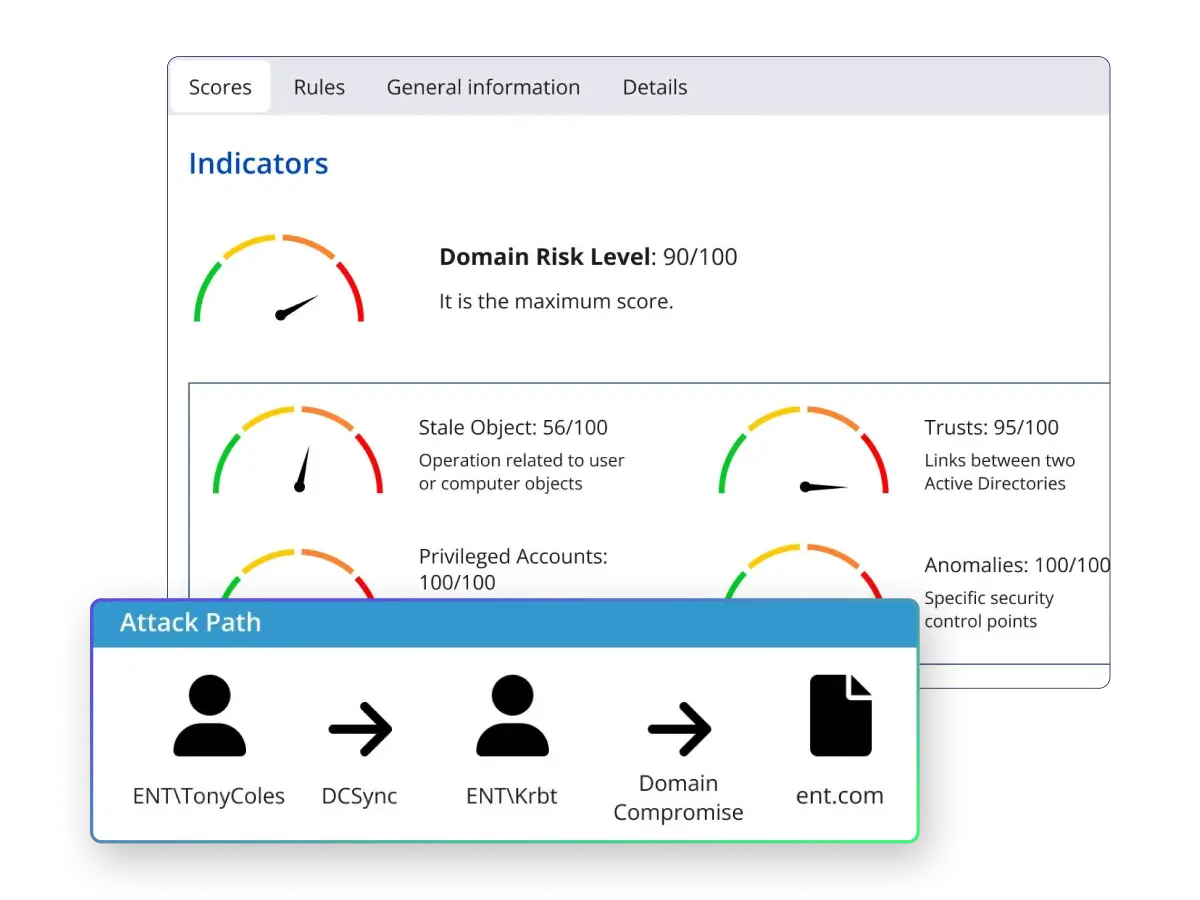
Risk assessment dashboards highlight the identity hygiene issues that make shadow AI more dangerous, including dormant accounts, excessive privileges, and synchronization gaps between on-premises Active Directory and Entra ID.
Netwrix is built for fast time-to-value. Netwrix 1Secure delivers high-impact outcomes from day one with no complex deployment, while Netwrix Auditor provides ready-to-read, human-readable reports that answer audit questions about AI-related data access in minutes rather than hours.
Compliance reporting maps directly to PCI DSS, HIPAA, SOC 2, GDPR, and CMMC, so the evidence an auditor requests is a report pull rather than a manual data collection exercise.
If your team needs visibility into shadow AI risk but cannot wait for a six-month implementation project, you need a platform that starts delivering answers on day one. Request a Netwrix demo to get started.
Frequently asked questions about shadow AI security risks
Share on
Learn More
About the author

Netwrix Team
Learn more on this subject
Data Privacy Laws by State: Different Approaches to Privacy Protection
What Is Electronic Records Management?
Regular Expressions for Beginners: How to Get Started Discovering Sensitive Data
External Sharing in SharePoint: Tips for Wise Implementation
How to Set Up an Azure Point-to-Site VPN Tunnel